Atlassino Academy · Blackjack · Lesson 1
Card values, soft and hard hands
The first thing a table asks you to know: what your cards add up to, and whether the ace among them can still be eleven.
You do not need to know anything about blackjack yet. How a round is played, who acts first and what the moves are all come later. Today you only count: what your cards add up to, and what the hand you are holding is called. Never sat at a table? Joining a table in the first-visit track shows you how.
You are dealt an ace and a six. What is the hand worth?
The short answer
An ace counts 1 or 11, whichever suits the hand. A jack, a queen and a king count ten; every other card counts the number printed on it. While an ace can still be eleven without taking the hand over 21, the hand is soft and has two totals at once; otherwise the hand is hard and has one total. A blackjack is 21 on your first two cards, an ace and a ten-value card, and no other 21 is a blackjack.
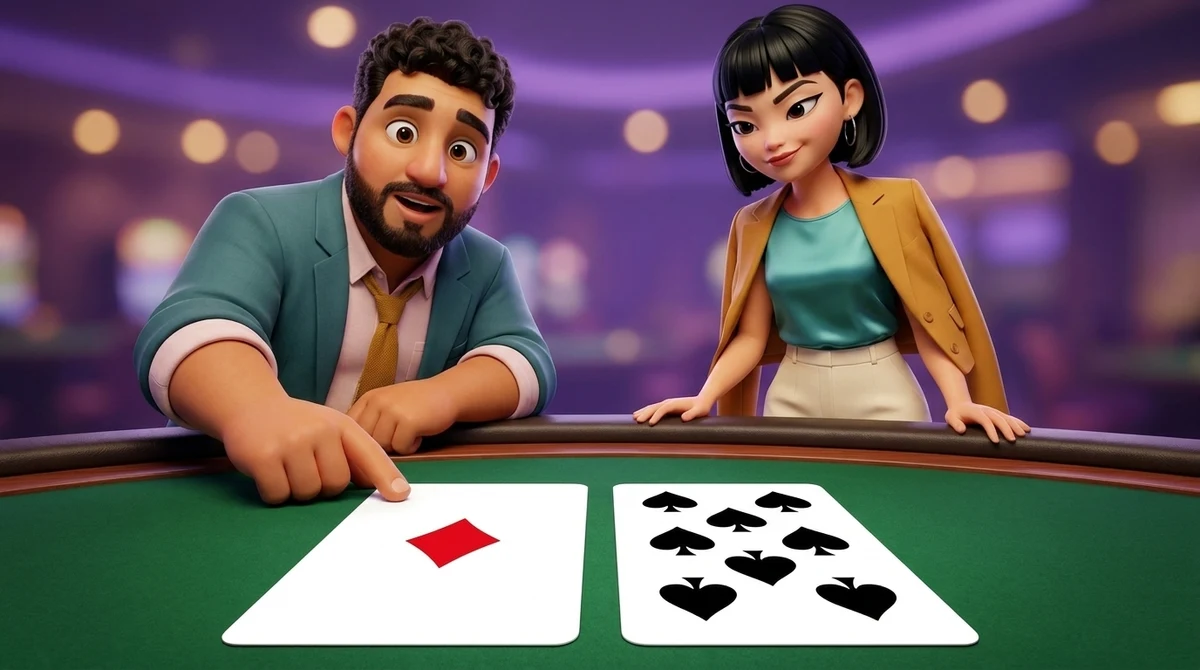

Leoformer dealer · rules and maths
I dealt this game before I taught it, and the quietest mistake at a table looks like this: the player makes the right move for a hand he is not holding. Every decision in blackjack is a decision about a number, so the number has to be the right one before anything else.
What each card is worth
You are trying to reach 21 or come close to it without going over, and you are playing against the dealer’s hand, not to reach 21 as such. The whole game sits in that one sentence, so the first skill to have is adding up the cards in your hand, quickly and without a mistake.
Cards 2 to 10 count the number printed on them
A jack, a queen and a king count ten, all three of them
The picture on the card is different; the value of the card is not.
An ace counts 1 or 11, whichever suits the hand
Cards come out of a shoe (the box the dealer deals from, holding several decks shuffled together) of 6 decks, and four of the thirteen kinds put ten on your hand: 30.8% of the cards in the box.
The ace: two numbers at once
The ace is the only card with two values: one or eleven, whichever suits the player or the dealer. There is nothing to announce: an ace that can still be eleven without taking the hand over 21 gives the hand two totals at once; once eleven no longer fits, the ace is one and the hand has one total. The words for the two cases are soft and hard, and the test is one question, the eleven question:
- Step 1Count the ace as one and add the hand up.An ace and a six: 1 + 6 is 7.
- Step 2Add ten to that total.7 + 10 is 17.
- Step 3Is the new total 21 or under?Yes: the ace can be eleven, the hand has two totals, and the hand is soft. No: the ace is one, the hand has one total, and the hand is hard.
Soft
7 or 17An ace and a six. With the ace at eleven the hand is 17, inside 21: two totals.
Hard, no ace
17A ten and a seven. No card in the hand has two values: one total.
Hard, with an ace
17A ten and a six, then an ace. With the ace at eleven the hand would be 27: the ace is one, and the hand has one total.
About one starting hand in 7 has an ace in it, so you will be asking the eleven question often.
When a soft hand turns hard
Every new card asks the eleven question again. Nobody at the table announces that the hand has turned hard; noticing that the ace has dropped to one is your job.
Before the card
7 or 17A soft 17.
A three comes
10 or 20Still soft: 11 + 6 + 3 is 20, inside 21.
A ten comes
17Hard now: with the ace at eleven the hand would be 27, so the ace is one.
Two aces never both count eleven: 11 + 11 is already 22. However many aces a hand holds, at most one of them is eleven.
Blackjack, and what is not one
One hand at this table has a name of its own: the blackjack (twenty-one on your first two cards: the one hand a table pays at a rate of its own). A blackjack is an ace and a ten-value card as your first two cards: 21 on two cards.
A blackjack
Paid 3 to 2The ace counts eleven and the king counts ten: 21 on the first two cards.
21 on three cards
Paid 1 to 1Five, six and ten add up to 21, and three cards made it, so the hand is 21 and not a blackjack.
A blackjack is worth knowing on sight because of what it pays: any other higher hand is paid 1 to 1, and a blackjack 3 to 2.
| Your hand | Paid at | Back, on an example bet of 10 units |
|---|---|---|
| Higher than the dealer’s hand | 1 to 1 | 10 units |
| A blackjack, when the dealer has no blackjack | 3 to 2 | 15 units |
| A blackjack against the dealer’s blackjack | push (a tie: your bet comes back and nothing is paid) | nothing: your bet comes back |
| 21 on three cards or more, or 21 after a split | 1 to 1 | 10 units |
Twenty-one built from three cards or more pays the ordinary 1 to 1, and against a blackjack it is the lower hand: a dealer’s blackjack pays none of the bets, and against your blackjack the dealer can only tie.
Twenty-one on a split hand. An ace and a ten-value card on a hand made by splitting a pair is 21 on two cards, and it is still not a blackjack: it is paid like a 21 built from more cards, 1 to 1.
Two blackjacks. When your blackjack meets a dealer’s first card that is an ace, a ten or a face card, the dealer takes one more card, because the dealer can only tie you. A blackjack against the dealer’s blackjack is a tie, and your bet comes back.
What a misread costs
A misread is a move made for a hand you are not holding. Read a hard 17 with an ace in it as a soft 17, and you take a card on a hand that the chart stands on.
A hard 17 read as soft, against a 7
3.69 unitsa hand, on an example bet of 10 units: what taking another card costs against standing.
A hard 18 read as soft, against a 9
4.28 unitsa hand, on an example bet of 10 units, for the same mistake.
Amounts are for an example bet of 10 units; at twice the bet, twice the cost. Amounts are in betting units, not pesos: a unit can stand for any amount, and the arithmetic is the same at any scale.
Even read correctly, every hand of the evening still costs: these rules leave the house 0.36% of every bet when every hand is played by the full chart. Reading the hand right keeps you from paying more than that.

Mayaformer floor supervisor · manners, money and breaks
Counting right is the first skill, and a limit set before you sit down is the second. If the money on the table starts to feel like money you need, stop there and read the box below: it says where self-exclusion and the regulator are reached.
If it stops being fun
If gambling stops being fun, the SCJ self-exclusion applies in every casino in the country. Minimum entry age: 18 (age of majority under Law 19.221; Law 19.995 bars minors from gaming rooms). The casino may ask for an official ID. More on responsible gaming.
Show all regions
Practice table
Four levels: two cards, one more card, more than one ace, and the dealer waiting with the price of a misread. Every answer is the reading of the cards on the felt.
Lesson done
Review my mistakes (0)
Progress stays in this browser; nothing is sent anywhere.
The practice table needs JavaScript. Here is one hand from it, with the answer.
Level 2 · One more card
Blackjack · 6 decks, dealt from a shoe
You
A four and a two, then an ace. What do you hold?
The answer: A soft 17.
Count the ace as one first: 1 + 4 + 2 is 7. With the ace at eleven the hand is 17, still inside 21. Two totals, and the hand is soft.
En este juego las figuras valen diez puntos, el as un punto u once, según convenga al jugador o al croupier, y las otras cartas tienen su valor nominal.Free translation: In this game the face cards are worth ten points, the ace one point or eleven, as suits the player or the dealer, and the other cards have their face value.
Superintendencia de Casinos de Juego (SCJ) · Catálogo de Juegos que podrán desarrollarse en los casinos de juego (texto de marzo 2023) · section III.1 Black Jack (modalidad Black Jack o Veintiuno); I. Cuestiones generales · readLevel 1 · Two cards
Blackjack · 6 decks, dealt from a shoe
You
An ace and a six. What do you hold?
The answer: A soft 17.
The ace counts one or eleven, whichever suits the hand. 1 + 6 is 7, and with the ace at eleven 17, still inside 21. Two totals at once, and the hand is soft.
En este juego las figuras valen diez puntos, el as un punto u once, según convenga al jugador o al croupier, y las otras cartas tienen su valor nominal.Free translation: In this game the face cards are worth ten points, the ace one point or eleven, as suits the player or the dealer, and the other cards have their face value.
Superintendencia de Casinos de Juego (SCJ) · Catálogo de Juegos que podrán desarrollarse en los casinos de juego (texto de marzo 2023) · section III.1 Black Jack (modalidad Black Jack o Veintiuno); I. Cuestiones generales · readEvery hand is read the same way: add the cards, then ask whether an ace among them can still be eleven.
Check yourself

Mayaformer floor supervisor · manners, money and breaks
Five quick ones. Pick an answer, then check it. No timer, no points: just whether it stuck.
And the question we opened with
An ace and a six: a soft 17, worth 7 or 17. The ace stays free to be eleven until a card takes the eleven away.
Where to play, and further reading
18+ across Chile · Play responsibly · the help box is further up this page
Further reading
- Catálogo de Juegos (Black Jack) · Superintendencia de Casinos de JuegoThe regulator’s rules for blackjack: six decks, how the dealer plays, doubling, splitting, retiro and the seguro.
- Funcionamiento de los juegos: Juegos de cartas · Superintendencia de Casinos de JuegoThe regulator’s plain-language page on card games: which games are allowed and what equipment is approved.
How it’s worked out
Rules, numbers and hosts
Soft and hard. The two words are the trade’s words, and the definition on this page is ours: a hand is soft while an ace in it can count eleven without the hand going over 21, and hard otherwise. The catalogue of games gives the card values and the ace’s two values and defines no soft or hard hand for this game; the practice table reads every hand by this definition.
Rules. The decks, the 3 to 2 and the figures follow the national catalogue of games that the Superintendencia de Casinos de Juego (SCJ) sets for every casino in Chile: six decks, blackjack paid 3 to 2, the dealer standing on 17, and every card dealt face up. The catalogue does not say what a dealer blackjack takes from a double or a split; the house edge assumes the costlier reading, that it takes every bet on the hand. It is a preset for learning, not a statement about any one casino.
Numbers. The share of ten-value cards is card arithmetic on the shoe. A misread’s cost is worked out by our blackjack engine: the average result of the chart’s move minus that of the move made for the wrong hand, for an example bet of 10 units, each average rounded to the hundredth first. The house edge assumes the full chart and cards shuffled after every hand.
Hosts. Leo and Maya are illustrated characters. Their backstories, a former dealer and a former floor supervisor, are written for the course: neither is a real person, and neither speaks for any casino. The rules and numbers on this page come from the sources it cites, not from their experience.
No promise. Blackjack is played against the house. Reading your hand correctly keeps you from paying more than the game already costs; nothing on this page removes that cost or says how an evening will end.
An ace counts two ways
En este juego las figuras valen diez puntos, el as un punto u once, según convenga al jugador o al croupier, y las otras cartas tienen su valor nominal.Free translation: In this game the face cards are worth ten points, the ace one point or eleven, as suits the player or the dealer, and the other cards have their face value.
Section III.1 Black Jack (modalidad Black Jack o Veintiuno); I. Cuestiones generales
Two blackjacks at once
En este caso, el croupier debe completar su mano con una carta adicional, ya que solo tiene la opción de empatar.Free translation: In this case, the dealer must complete his hand with an additional card, since he only has the option of tying.
Section III.1 Black Jack (modalidad Black Jack o Veintiuno); I. Cuestiones generales
What a blackjack is
tienen una cuenta de 21 con dos cartas, jugada denominada “Black Jack”.Free translation: have a count of 21 with two cards, a play called "Black Jack".
Section III.1 Black Jack (modalidad Black Jack o Veintiuno); I. Cuestiones generales
The object of the game
El Black Jack es un juego de cartas cuyo objeto es alcanzar veintiún puntos o acercarse a ellos sin pasar de este límite. Los participantes juegan a ganarle al croupier y no necesariamente a obtener veintiún puntos.Free translation: Black Jack is a card game whose object is to reach twenty-one points or get close to them without going over this limit. The participants play to beat the dealer and not necessarily to obtain twenty-one points.
Section III.1 Black Jack (modalidad Black Jack o Veintiuno); I. Cuestiones generales
Card values
En este juego las figuras valen diez puntos, el as un punto u once, según convenga al jugador o al croupier, y las otras cartas tienen su valor nominal.Free translation: In this game the face cards are worth ten points, the ace one point or eleven, as suits the player or the dealer, and the other cards have their face value.
Section III.1 Black Jack (modalidad Black Jack o Veintiuno); I. Cuestiones generales
Card values in one sentence
En este juego las figuras valen diez puntos, el as un punto u once, según convenga al jugador o al croupier, y las otras cartas tienen su valor nominal.Free translation: In this game the face cards are worth ten points, the ace one point or eleven, as suits the player or the dealer, and the other cards have their face value.
Section III.1 Black Jack (modalidad Black Jack o Veintiuno); I. Cuestiones generales
An ace counts two ways
En este juego las figuras valen diez puntos, el as un punto u once, según convenga al jugador o al croupier, y las otras cartas tienen su valor nominal.Free translation: In this game the face cards are worth ten points, the ace one point or eleven, as suits the player or the dealer, and the other cards have their face value.
Section III.1 Black Jack (modalidad Black Jack o Veintiuno); I. Cuestiones generales
What a blackjack is
tienen una cuenta de 21 con dos cartas, jugada denominada “Black Jack”.Free translation: have a count of 21 with two cards, a play called "Black Jack".
Section III.1 Black Jack (modalidad Black Jack o Veintiuno); I. Cuestiones generales
What a hand is paid
Si el jugador hace un juego diferente a Black Jack 1 a 1 (a la par)Free translation: If the player makes a hand other than Black Jack, 1 to 1 (even money)
Section III.1 Black Jack (modalidad Black Jack o Veintiuno); I. Cuestiones generales
What a blackjack is paid
Si el jugador hace Black Jack 1 a 1 (a la par) 1a1 3a2Free translation: If the player makes Black Jack, 1 to 1 (even money) 1a1 3a2
Section III.1 Black Jack, Pago de apuestas, a) General
A two-card 21 and a 21 built from more cards
En este caso, el croupier debe completar su mano con una carta adicional, ya que solo tiene la opción de empatar.Free translation: In this case, the dealer must complete his hand with an additional card, since he only has the option of tying.
Si el croupier tiene Black Jack no paga las apuestas.Free translation: If the dealer has Black Jack he does not pay the bets.
Section III.1 Black Jack (modalidad Black Jack o Veintiuno); I. Cuestiones generales
Twenty-one after a split
Si un jugador separa un par de ases o un par de cartas que valgan 10 puntos cada una, y en cualquiera de sus dos manos totaliza 21 puntos con dos cartas, esta jugada no se considera como Black Jack.Free translation: If a player splits a pair of aces or a pair of cards worth 10 points each, and in either of the two hands totals 21 points with two cards, this play is not considered Black Jack.
Por lo tanto, si le corresponde pago éste es equivalente a hacer 21 con más de dos cartas.Free translation: Therefore, if a payout is due, it is equivalent to making 21 with more than two cards.
Section III.1 Black Jack (modalidad Black Jack o Veintiuno); I. Cuestiones generales
Two blackjacks at once
En este caso, el croupier debe completar su mano con una carta adicional, ya que solo tiene la opción de empatar.Free translation: In this case, the dealer must complete his hand with an additional card, since he only has the option of tying.
Section III.1 Black Jack (modalidad Black Jack o Veintiuno); I. Cuestiones generales