Atlassino Academy · Track 3
Blackjack lessons
Blackjack under the national catalogue of games: what the cards count, a round with every card face up, hit, stand, double, split and the retiro, why you act before the dealer, hard totals, doubling on 9, 10 or 11, soft hands, the whole chart, the catalogue’s three blackjacks, insurance, the Perfect Pairs side bet and the myths of the table.
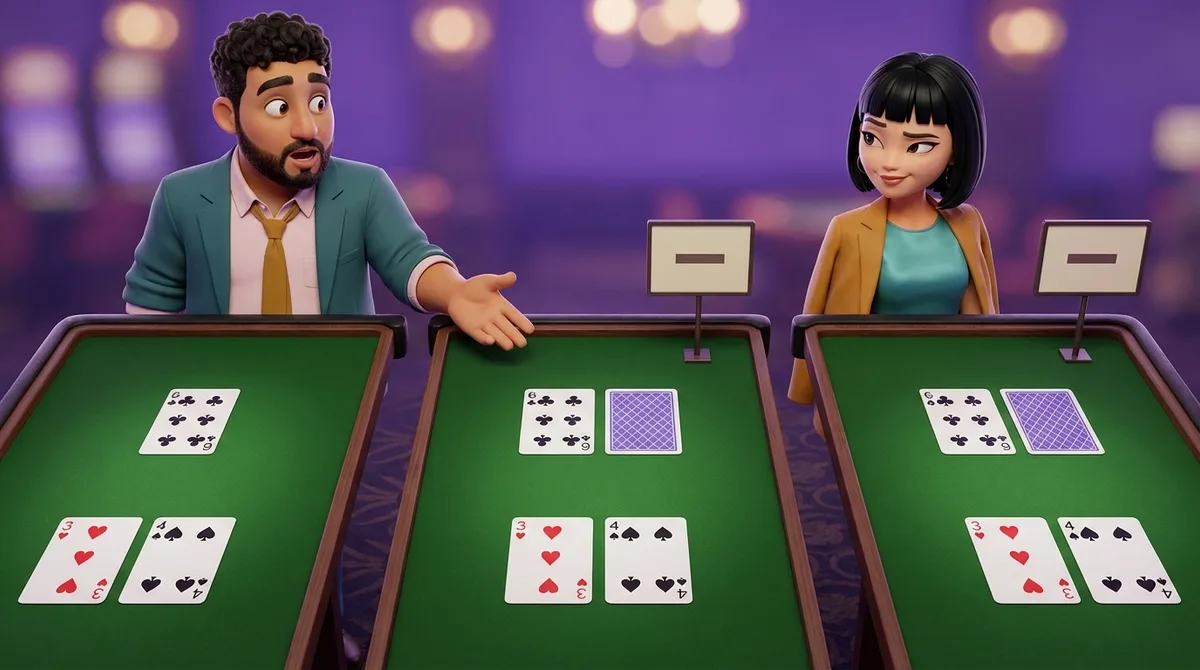
Start with 3.1 Card values, soft and hard hands
The lessons in this track
- 3.1Card values, soft and hard handsThe first thing a table asks you to know: what your cards add up to, and whether the ace among them can still be eleven.About 14 minutes
- 3.2One round, every card face upA round of blackjack under Chile’s catalogue of games, step by step: no face-down card, and the dealer’s second card only after every player has finished.About 12 minutes
- 3.3Hit, stand, double, split, retiroThe five moves a blackjack hand allows under Chile’s catalogue of games: when you may double, split or take the retiro, and what each move is worth.About 13 minutes
- 3.5Why you act first, and what it costsWhere the house edge in blackjack comes from, priced hand by hand for the table rules the Superintendencia de Casinos de Juego (SCJ) sets for every casino in Chile.About 18 minutes
- 3.6When to hit or stand on a hard totalThe decision you face on most blackjack hands, worked out for the catalogue of games the Superintendencia de Casinos de Juego (SCJ) sets for every casino in Chile.About 18 minutes
- 3.7Doubling down: a second bet on one cardA second bet that buys exactly one card: the three totals these rules let you double, when the chart asks for it, and what each call costs.About 15 minutes
- 3.8Soft hands: the ace that can't bust youThe hands where an ace still counts as 11, and what to do with them when the rules let you double only on 9, 10 or 11.About 13 minutes
- 3.10The whole chart and your printed cardThree tables on one page, and your own two cards decide which of them you read. The whole chart, the movement of the eye that finds one cell, and a card to print.About 19 minutes
- 3.11One catalogue, three blackjacksChile’s catalogue of games has three blackjacks — Black Jack, Challenge 21 and Canal 21 — under one name and three sets of rules: what changes, and what it does to the price.About 14 minutes
- 3.12Insurance and even moneyThe offer that comes with an ace showing: what the insurance line is a bet on, how much the rules let you put there, and what even money is.About 15 minutes
- 3.13Side bets: the price per hourThe second bet beside the hand is a bet of its own, with a pay table of its own and a price of its own by the hour.About 14 minutes
- 3.17Third base, hot tables and the table's moodThe seat at the end of the table, the table that is said to be running hot, and what a neighbour’s decision can and cannot do to your hand.About 14 minutes
What this track is for
Every figure in these lessons is worked out when the page is built, by the same engines as our tools, or comes from a source quoted on the spot. More on how we verify.
Nothing here is a way to win. The course explains what each game costs to play and what the rules on the table actually change, so that the money you take in is a decision and not a surprise.
Nothing you do in a practice table leaves your browser: what you answered is kept on this device and is sent nowhere. The course page lists what this device has saved.
If it stops being fun
If gambling stops being fun, the SCJ self-exclusion applies in every casino in the country. Minimum entry age: 18 (age of majority under Law 19.221; Law 19.995 bars minors from gaming rooms). The casino may ask for an official ID. More on responsible gaming. The self-exclusion guide lists the programmes you can sign yourself into and the casinos each one covers.