An ace and a 6 against a 10, kept
2.08 unitseach time you stand on a soft 17 against a 10 instead of taking a card. Against a 6, 1.17 units.
Fix: soft 17 or less, take a card.
Atlassino Academy · Blackjack · Lesson 8
The hands where an ace still counts as 11, and what to do with them when the rules let you double only on 9, 10 or 11.
A soft hand is a hand where an ace counts 11 and can still drop to 1. The ace counts one or eleven, whichever suits the hand, so one card cannot take a soft hand over 21: at worst the ace steps down.
You are dealt an ace and a 7: soft 18. The dealer shows a 9. Do you stand on 18, or take a card?
Soft 13 to 17: take a card, against every dealer card. Soft 18: stand against a 2 to 8, take a card against a 9, a 10 or an ace. Soft 19 and 20: stand. There is no double anywhere in these rows: at these tables a double is allowed only on two cards that make 9, 10 or 11.
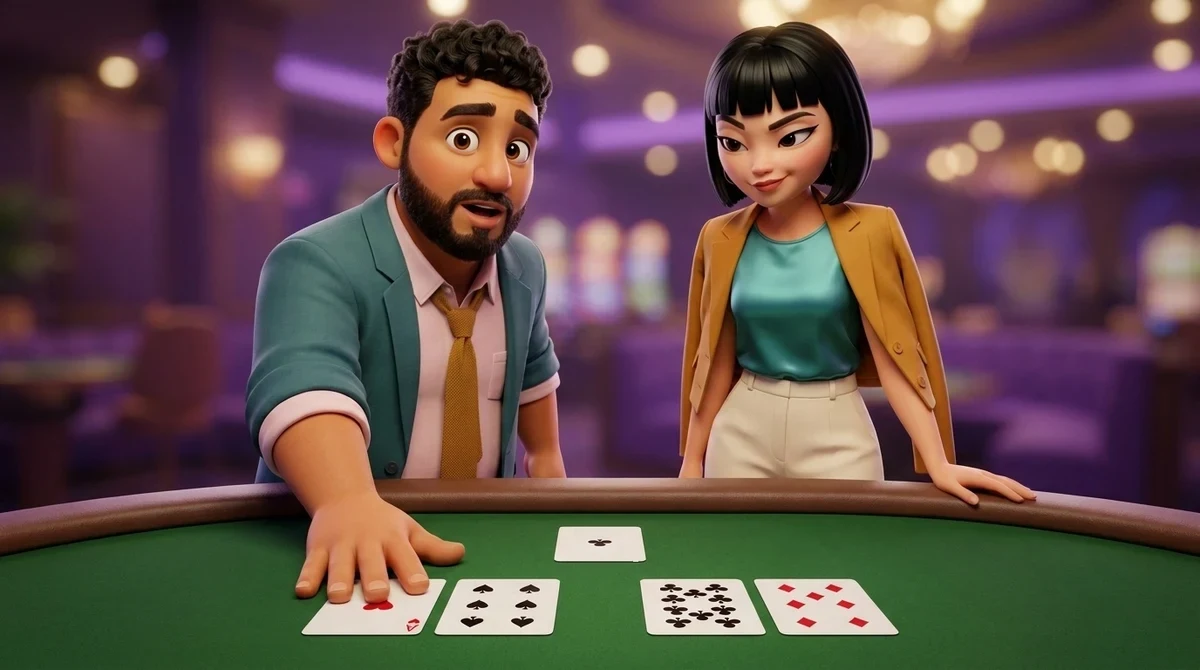

Leoformer dealer · rules and maths
A soft hand is the one hand at the table you can draw to without fear of going over. The chart uses that: it keeps drawing to every soft total up to 17, and the only real decision is on 18.
Put a 10 on a hard 17 and the hand is over 21. Put the same 10 on a soft 17 and the ace simply drops to 1: the hand becomes a hard 17 and is still in play. The table below shows every card you could take.
| Your hand | The card you take | |||||||||
|---|---|---|---|---|---|---|---|---|---|---|
| A | 2 | 3 | 4 | 5 | 6 | 7 | 8 | 9 | 10 | |
| A hard 17 — a 10 and a 7 | 18 | 19 | 20 | 21 | 22 — over 21, hand lost | 23 — over 21, hand lost | 24 — over 21, hand lost | 25 — over 21, hand lost | 26 — over 21, hand lost | 27 — over 21, hand lost |
| A soft 17 — an ace and a 6 | 18 | 19 | 20 | 21 | 12 | 13 | 14 | 15 | 16 | 17 |
Each cell is where the hand lands after one card of that value; the jack, queen and king land where the 10 does. The hard 17 goes over 21 on every card from a 5 up; the soft 17 never does. A soft 17 tops out at 21 with one card.
Six decks · the dealer stands on every 17 · double on 9, 10 or 11 only · house edge 0.36% with the full chart
| Soft | 2 | 3 | 4 | 5 | 6 | 7 | 8 | 9 | 10 | A |
|---|---|---|---|---|---|---|---|---|---|---|
| A,2 | H | H | H | H | H | H | H | H | H | H |
| A,3 | H | H | H | H | H | H | H | H | H | H |
| A,4 | H | H | H | H | H | H | H | H | H | H |
| A,5 | H | H | H | H | H | H | H | H | H | H |
| A,6 | H | H | H | H | H | H | H | H | H | H |
| A,7 | S | S | S | S | S | S | S | H | H | H |
| A,8 | S | S | S | S | S | S | S | S | S | S |
| A,9 | S | S | S | S | S | S | S | S | S | S |
Soft 13 to 17: take a card, against every dealer card. None of these totals is worth keeping, and the next card cannot break the hand.
Soft 18: it depends on the dealer’s card. Stand against a 2 to 8, take a card against a 9, a 10 or an ace.
Soft 19 and 20: stand, against every dealer card.
Here is the same chart, row by row, in words:
Eighteen feels like a hand to keep, and against most dealer cards it is. Against a 9, a 10 or an ace it is not: against those three cards the dealer finishes above 18 often enough that taking a card, which cannot take a soft 18 over 21, does better on average than standing.
| Dealer shows | Stand on 18 | Take a card | The chart says |
|---|---|---|---|
| an 8 | +1.08 units | +0.41 units | Stand |
| a 9 | −1.83 units | −0.98 units | Take a card |
| a 10 | −2.41 units | −2.07 units | Take a card |
| an ace | −3.80 units | −3.76 units | Take a card |
Amounts are averages per hand for an example bet of 10 units, an example and not a suggested bet. Amounts are in betting units, not pesos: a unit can stand for any amount, and the arithmetic is the same at any scale. A plus sign is an average over many hands; any one hand can still lose.
The catalogue allows a double when your first two cards make 9, 10 or 11, for the same amount as your first bet, and the double buys exactly one card. The chart reads a soft hand with its ace counted 11 — an ace and a 6 is a soft 17 — so its soft rows take a card or stand, and never double. Where the chart does double, on hard 9, 10 and 11, is the doubling lesson.
An ace you draw later counts the same way: 11 while that keeps the hand at 21 or under, and 1 after that. A 2, a 5 and an ace is a soft 18 like an ace and a 7, and it reads off the same row of the chart. The moment a card would take the ace past 21, the hand turns hard, and the hard-totals chart in the previous lesson answers it from there.
No amounts are shown for hands of three cards: our figures are worked out for two-card hands.
Amounts are for an example bet of 10 units; at twice the bet, twice the cost.
each time you stand on a soft 17 against a 10 instead of taking a card. Against a 6, 1.17 units.
Fix: soft 17 or less, take a card.
each time you stand on a soft 18 against a 10. Against a 9, 0.85 units; against an ace, 0.04 units.
Fix: soft 18 against a 9, a 10 or an ace, take a card.
The house keeps its edge; the chart only makes it smaller. Play every cell of the chart and these rules still leave the house 0.36% of every bet.

Mayaformer floor supervisor · manners, money and breaks
A soft hand that keeps drawing can make a hand feel long, and a long hand can make an evening feel like it owes you something. It does not. Decide your time and your money before you sit down, and keep to them. If the money starts to feel like money you need, stop for the evening.
If gambling stops being fun, the SCJ self-exclusion applies in every casino in the country. Minimum entry age: 18 (age of majority under Law 19.221; Law 19.995 bars minors from gaming rooms). The casino may ask for an official ID. More on responsible gaming.
Two levels: first a soft hand on the two cards you are dealt, then a soft hand of three cards with the ace drawn third. Every answer is a cell of the chart for these rules, read from the engine, and the only moves are to stand or to take a card: the soft rows hold no double. Amounts are for an example bet of 10 units, an example and not a suggested bet; hands of three cards carry no amount.
Progress stays in this browser; nothing is sent anywhere.
The practice table needs JavaScript. Here is one hand from it, with the answer.
Dealer shows a 4
You
Your hand an ace and a 4
You are dealt an ace and a 4: soft 15. The dealer shows a 4. What does the chart say?
On a soft 15 against a 4 the chart says take a card: standing averages −2.04 units a hand, taking a card +0.59 units. There is no double on a soft hand at these tables.
One strip, no rounds. Every square on the strip is one hand of this lesson, and they are all there from the start. The square keeps your first answer; when a level’s squares are full the next level begins by itself.
Levels. Level 1: an ace and a 2 to 9 as your first two cards, against the dealer’s card. Level 2: soft hands of three cards, with the ace as the third card.

Mayaformer floor supervisor · manners, money and breaks
Five quick ones. Pick an answer, then check it. No timer, no points: just whether it stuck.
An ace and a 7 against a 9: take a card. Standing averages −1.83 units a hand on an example bet of 10 units, taking a card −0.98 units.
18+ across Chile · Play responsibly · the help box is further up this page
Rules. The figures on this page follow the rules the SCJ sets out for blackjack in its national catalogue of games: six decks, the dealer standing on every 17, a double on two cards that make 9, 10 or 11, surrender for half the bet except against an ace, and every card dealt face up, with the dealer’s second card dealt after the players. Whether an ace and an 8, or an ace and a 9, counted with the ace as one, may be doubled as a 9 or a 10, the catalogue does not say; the chart counts them as a soft 19 and a soft 20. What a dealer blackjack takes from a double or a split the catalogue does not say either; the house edge assumes it takes every bet on the hand. It is a preset for learning, not a statement about any one casino.
Numbers. Every figure is worked out when the page is built, by our blackjack engine. A cost is the difference of two averages for an example bet of 10 units, each rounded to the hundredth first. The landing totals are card arithmetic. The averages are worked out for two-card hands, so hands of three cards carry no amount.
Hosts. Leo and Maya are illustrated characters. Their backstories, a former dealer and a former floor supervisor, are written for the course: neither is a real person, and neither speaks for any casino. The rules and numbers on this page come from the sources it cites, not from their experience.
No promise. Blackjack is played against the house. The chart lowers the price of playing; nothing on this page removes that price or tells you how an evening will end.
An ace counts two ways
En este juego las figuras valen diez puntos, el as un punto u once, según convenga al jugador o al croupier, y las otras cartas tienen su valor nominal.Free translation: In this game the face cards are worth ten points, the ace one point or eleven, as suits the player or the dealer, and the other cards have their face value.
Section III.1 Black Jack (modalidad Black Jack o Veintiuno); I. Cuestiones generales
Doubling in the catalogue
Cuando el jugador obtiene 9,10 u 11 puntos con las dos primeras cartas, tiene la opción de incrementar su apuesta original. Este incremento debe efectuarse por el mismo monto de su apuesta original.Free translation: When the player obtains 9,10 or 11 points with the first two cards, he has the option of increasing his original bet. This increase must be made for the same amount as his original bet.
Section III.1 Black Jack (modalidad Black Jack o Veintiuno); I. Cuestiones generales
Cuando se aumenta la apuesta el jugador tiene derecho a una sola carta adicional.Free translation: When the bet is increased, the player is entitled to only one additional card.
Section III.1 Black Jack (modalidad Black Jack o Veintiuno); I. Cuestiones generales
Doubling in Chile
Cuando el jugador obtiene 9,10 u 11 puntos con las dos primeras cartas, tiene la opción de incrementar su apuesta original.Free translation: When the player obtains 9,10 or 11 points with the first two cards, he has the option of increasing his original bet.
Cuando se aumenta la apuesta el jugador tiene derecho a una sola carta adicional.Free translation: When the bet is increased, the player is entitled to only one additional card.
Section III.1 Black Jack, e) Apuesta doble
An ace counts two ways
En este juego las figuras valen diez puntos, el as un punto u once, según convenga al jugador o al croupier, y las otras cartas tienen su valor nominal.Free translation: In this game the face cards are worth ten points, the ace one point or eleven, as suits the player or the dealer, and the other cards have their face value.
Section III.1 Black Jack (modalidad Black Jack o Veintiuno); I. Cuestiones generales
The deal in Chile
Cuando se hayan efectuado todas las apuestas el croupier distribuye una carta a cada mano, comenzando por su izquierda y siguiendo el sentido de las agujas del reloj. Luego el mismo se da una carta.Free translation: When all the bets have been placed, the dealer deals one card to each hand, starting from his left and proceeding clockwise. Then he deals himself a card.
Todas las cartas se distribuyen siempre descubiertas.Free translation: All cards are always dealt face up.
Una vez que los jugadores han hecho su juego, el croupier termina su mano, dándose a sí mismo una o varias cartasFree translation: Once the players have made their play, the dealer finishes his hand, giving himself one or several cards
Section III.1 Black Jack, Distribución de cartas; a) Juego simple