Atlassino Academy · Blackjack · Lesson 12
Insurance and even money
The offer that comes with an ace showing: what the insurance line is a bet on, how much the rules let you put there, and what even money is.
The dealer’s first card is an ace, every player has two cards, and before anyone has drawn, the dealer offers insurance. What is that offer asking you to put money on?
The short answer
Insurance is a second bet of your own money, placed on a line of its own in front of your place. It rides on the dealer’s first two cards making a blackjack, it is settled on its own and has no bearing on the bet you came to play, and the house keeps a far larger share of the money on the insurance line than of the money on your own bet.
The dealer
Your cards
Your two cards are face up, and no decision has been made on them yet.Your own bet
The insurance line
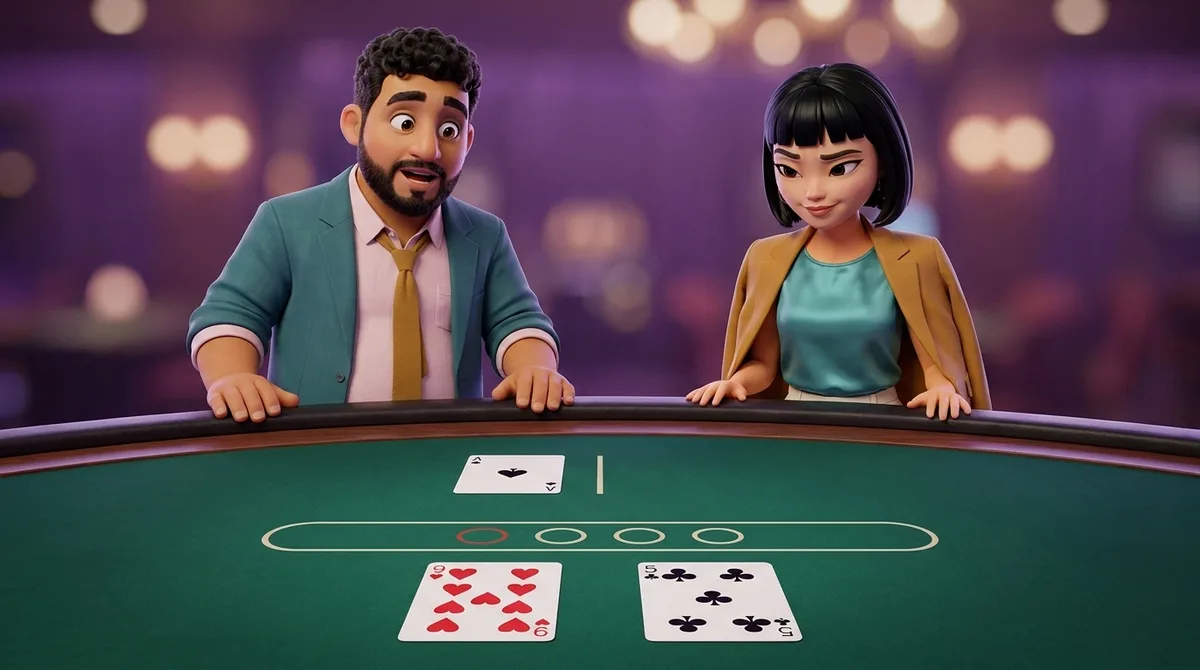
What the insurance offer is a bet on
The offer arrives at one moment. The dealer’s first card is an ace, every player still in the hand has a second card, and the dealer has not yet taken a second card. That is when the dealer offers insurance to the players, and it comes before anyone has drawn: a player who takes it and then goes over 21 has already put the money down.
What the money is on is the dealer’s blackjack. Every card at these tables is dealt face up, and the dealer takes one card in the deal and the rest only after the players have played, so the card the insurance bet rides on has not been dealt at the moment you are asked to bet on it.
Your own bet is the full length; the insurance line may take up to half of your own bet.
The insurance bet is capped by the bet you already have in front of you: the catalogue lets you put up to half of that bet on the insurance line. It is not added to your own bet, and its result has no bearing on your own bet.
| Your own bet | The insurance bet | |
|---|---|---|
| What it is settled against | your own hand against the dealer’s hand | whether the dealer’s first two cards make a blackjack, and nothing else |
| Where the money sits | the betting spot in front of you | the insurance line in front of your place |
| How large it may be | the amount you put down before the deal | up to one half of your own bet |
| When the money goes down | before the deal begins | once every player has a second card, and before the dealer takes a second card |
| When it is settled | once the dealer’s hand has been finished | when the dealer’s first two cards are known, and the dealer takes the second card after the players have played |
| What it is paid | 1 to 1, and 3 to 2 on a blackjack | 2 to 1 |
When the dealer’s second card arrives, the insurance bet is settled in one of two ways.
The insurance line is paid 2 to 1
The dealer has a blackjack, and the insurance bets on the table are paid at 2 to 1.
The insurance line is taken
The dealer checks the first two cards, says there is no blackjack, and takes the insurance bets.
Leoformer dealer · rules and maths
Count the bets rather than the moves. Two bets sit on the felt: one on how your hand finishes against the dealer’s, the other on what one particular card turns out to be.
What the dealer’s second card has to be
The insurance bet is paid on one thing: the dealer’s second card being worth ten. Four ranks are worth ten — the ten itself, the jack, the queen and the king — because every face card counts as ten and every other card counts what it says.
How often such a card comes off the shoe is a matter of counting the shoe. A blackjack table in Chile is dealt from six decks, and a full six-deck shoe with the dealer’s ace taken out of it and no other card counted holds 96 cards worth ten and 215 cards worth something else. At a real table the players’ cards are face up on the felt as well, and this count does not follow them.
Put the payout and the count together and the insurance line has a price, the same way the bet you came to play has one: of the money placed on that line, 7.40% stays with the house on average. That share is worked out from a full six-deck shoe with the dealer’s ace taken out of it and no other card counted, which is the arithmetic of the offer rather than a reading of any particular shoe.
The share on your own bet assumes the whole chart and, where the catalogue is silent on what a dealer blackjack takes from a double or a split, the dearer reading: every bet on the hand.
The 1 to 1 offer on a blackjack
There is one hand where the dealer makes a different offer. If your first two cards are a blackjack and the dealer’s first card is an ace, the dealer offers to pay your bet 1 to 1 at once and take your cards; you may refuse and wait for the dealer’s hand instead. If you accept, your hand is over, and you cannot place the insurance bet as well.
| The dealer’s second card makes a blackjack | The dealer’s second card does not | |
|---|---|---|
| You take the 1 to 1 | 1 to 1, paid at once, and your hand is over | 1 to 1, paid at once, and your hand is over |
| You wait for the dealer’s hand | a tie: nothing paid, nothing taken | 3 to 2 |
A blackjack that waits is paid at 3 to 2, except when the dealer’s second card makes a blackjack too, and then the hand is a tie: the dealer can only tie a blackjack, and nothing is paid or taken. So the choice at that moment is between one amount every time and two amounts that depend on one card. In money it is the same as insuring the blackjack for half its bet: either way you come away with one bet, whatever the dealer’s second card is. That is our arithmetic, not a line of the catalogue, and it is why the 1 to 1 carries the same price as the insurance line.

Mayaformer floor supervisor · manners, money and breaks
Decide how much money the evening gets and how long it runs before you sit down, and stop when either one is used up. The insurance line is worth naming in that plan, because it is the one moment in a hand when the table asks you for more money before you have drawn a card, and a second bet put down because the moment feels urgent is money spent rather than money saved. A run of losing hands is not a debt the table owes you, and putting more down to get it back only makes the hour dearer. If the money on the table starts to feel like money you need, stop for the evening.
If it stops being fun
If gambling stops being fun, the SCJ self-exclusion applies in every casino in the country. Minimum entry age: 18 (age of majority under Law 19.221; Law 19.995 bars minors from gaming rooms). The casino may ask for an official ID. More on responsible gaming.
Show all regions
Practice table
The practice table deals hands from a shuffled shoe and checks your first decision on each hand against the chart for the rules on this page. Decide with the buttons or with the keys H, S, D and R; R, surrender, is not offered against an ace, the same card that brings the insurance offer. Every square on the strip is one hand, only your first move on each hand is counted, and when a level’s squares are full the next level begins by itself. There is no money on the practice table: the amounts beside each decision are averages for the example bet you choose.
The insurance offer is not one of the buttons on the practice table, and that is on purpose. Insurance is a bet rather than a way of playing a hand, and what the practice table grades is the decision the chart answers: hit, stand, double or surrender. The offer itself is checked by the questions further down.
These are the rules the Superintendencia de Casinos de Juego (SCJ) sets for every casino in Chile; this table answers by the chart for those rules. The bet is only an example for the amounts shown, not a suggested bet.
Dealer
You
Lesson done
Review my mistakes (0)
Progress stays in this browser; nothing is sent anywhere.
The practice table needs JavaScript. Here is one hand from it, with the answer.
Dealer shows a 7
You hard 16
The chart says: Hit.
Hard 16 against a 7: The dealer card is strong: standing on 16 loses whenever the dealer finishes on 17 or more, 73.8% of hands against a 7.
Average result per hand on an example bet of 10 units (a minus means money lost): stand −4.77 units · hit −4.09 units. Standing instead costs about 0.68 units more each time.
Check yourself

Mayaformer floor supervisor · manners, money and breaks
Five quick ones. Pick an answer, then check it. No timer, no points: just whether it stuck.
The ace showing on the table asks you for a second bet, and that bet is on the dealer’s blackjack: not on the two cards in front of you, and not on how your own hand finishes.
Where to play, and further reading
18+ across Chile · Play responsibly · the help box is further up this page
Further reading
- Catálogo de Juegos (Black Jack) · Superintendencia de Casinos de JuegoThe regulator’s rules for blackjack: six decks, how the dealer plays, doubling, splitting, retiro and the seguro.
- Funcionamiento de los juegos: Juegos de cartas · Superintendencia de Casinos de JuegoThe regulator’s plain-language page on card games: which games are allowed and what equipment is approved.
How it’s worked out
Rules, numbers and hosts
Where this happens. Every table on this page is a blackjack table standing in a room you can walk into, and the rules it follows are the ones the SCJ sets out in its national catalogue of games. That catalogue sets out more than one blackjack game, and every table on this page is the basic game out of it: a table run as one of the other games in the same catalogue is not described here, and its insurance can differ from the bet on this page.
Numbers. Four numbers on this page are worked out when the page is built. The count of cards worth ten and the count of every other card come from the six decks the catalogue puts in the shoe, with the dealer’s ace taken out of them. The share of the money on the insurance line that stays with the house is 2 to 1 paid against that count. The share the house keeps of your own bet is worked out by our blackjack engine for these table rules, assuming the full chart — hard totals, soft hands and pairs together — and cards shuffled after every hand.
What is deliberately absent. There is no figure here for how often the dealer’s second card is worth ten at the table you are sitting at, because that changes as cards leave the shoe and nothing on this page follows them. There is no figure for what the insurance line costs over an evening, and no advice about when to take the offer or refuse it. The price of the bet is a price, and a price is all this page puts on it.
Hosts. Maya and Leo are illustrated characters. Their backstories, a former floor supervisor and a former dealer, are written for the course: neither is a real person, and neither speaks for any casino. The rules and numbers on this page come from the sources it cites, not from their experience.
No promise. Blackjack is played against the house. Nothing on this page makes the game free of cost, and nothing on it says how an evening will end.
What the game is
El Black Jack es un juego de cartas cuyo objeto es alcanzar veintiún puntos o acercarse a ellos sin pasar de este límite. Los participantes juegan a ganarle al croupier y no necesariamente a obtener veintiún puntos.Free translation: Black Jack is a card game whose object is to reach twenty-one points or get close to them without going over this limit. The participants play to beat the dealer and not necessarily to obtain twenty-one points.
Section III.1 Black Jack (modalidad Black Jack o Veintiuno); I. Cuestiones generales
What the insurance offer is
Cuando la primera carta de la banca es un as, todos los jugadores tienen la opción de asegurarse contra el posible Black Jack de la banca.Free translation: When the dealer's first card is an ace, all players have the option of insuring themselves against a possible Black Jack for the dealer.
El seguro es una apuesta adicional, en la cual el jugador apuesta a que la banca tiene Black Jack en sus dos cartas originales y se paga en una proporción 2 a 1 del monto apostado a ésta.Free translation: Insurance is an additional bet, in which the player bets that the dealer has Black Jack in their two original cards, and it is paid at a ratio of 2 to 1 of the amount wagered on it.
El resultado de esta apuesta no tiene influencia sobre la apuesta original.Free translation: The result of this bet has no influence on the original bet.
Section III.1 Black Jack (modalidad Black Jack o Veintiuno); I. Cuestiones generales
How much may go on the insurance line
El jugador que se asegure debe depositar sobre la línea seguro de la mesa, situada enfrente de su puesto, una cantidad como máximo igual al 50% del monto de su apuesta original.Free translation: A player who takes insurance must place on the insurance line of the table, located in front of their position, an amount at most equal to 50% of the amount of their original bet.
Section III.1 Black Jack (modalidad Black Jack o Veintiuno); I. Cuestiones generales
When the offer comes
El croupier debe ofrecer este seguro al conjunto de jugadores que aún tengan sus apuestas al terminar la ronda de entrega de la segunda carta obligatoria y antes de tomar la segunda carta de la banca.Free translation: The dealer must offer this insurance to all the players who still have their bets in play at the end of the round of dealing the second mandatory card and before taking the dealer's second card.
Si éstos aceptan apostar el seguro y al solicitar cartas adicionales se pasan de 21 puntos, la banca retira las apuestas originales y procede a tomar su segunda carta.Free translation: If they accept to bet on insurance and, when requesting additional cards, go over 21 points, the dealer removes the original bets and proceeds to take the dealer's second card.
Section III.1 Black Jack (modalidad Black Jack o Veintiuno); I. Cuestiones generales
The order of a hand
Cuando se hayan efectuado todas las apuestas el croupier distribuye una carta a cada mano, comenzando por su izquierda y siguiendo el sentido de las agujas del reloj. Luego el mismo se da una carta.Free translation: When all the bets have been placed, the dealer deals one card to each hand, starting from his left and proceeding clockwise. Then he deals himself a card.
Todas las cartas se distribuyen siempre descubiertas.Free translation: All cards are always dealt face up.
Una vez que los jugadores han hecho su juego, el croupier termina su mano, dándose a sí mismo una o varias cartasFree translation: Once the players have made their play, the dealer finishes his hand, giving himself one or several cards
Section III.1 Black Jack, Distribución de cartas; a) Juego simple
What a hand is paid
Si el jugador hace un juego diferente a Black Jack 1 a 1 (a la par)Free translation: If the player makes a hand other than Black Jack, 1 to 1 (even money)
Section III.1 Black Jack (modalidad Black Jack o Veintiuno); I. Cuestiones generales
Si el jugador hace Black Jack 1 a 1 (a la par) 1a1 3a2Free translation: If the player makes Black Jack, 1 to 1 (even money) 1a1 3a2
Section III.1 Black Jack, Pago de apuestas, a) General
What the insurance line pays
El seguro es una apuesta adicional, en la cual el jugador apuesta a que la banca tiene Black Jack en sus dos cartas originales y se paga en una proporción 2 a 1 del monto apostado a ésta.Free translation: Insurance is an additional bet, in which the player bets that the dealer has Black Jack in their two original cards, and it is paid at a ratio of 2 to 1 of the amount wagered on it.
Section III.1 Black Jack (modalidad Black Jack o Veintiuno); I. Cuestiones generales
What happens when the dealer has no blackjack
La verificación del resultado de estas apuestas se realiza cuando el croupier revisa sus cartas iniciales, momento en el cual indicará si tiene o no Black Jack; en caso afirmativo, procede a pagar dichas apuestas y, en el caso negativo, a retirarlas.Free translation: The result of these bets is checked when the dealer looks at their initial cards, at which point the dealer will indicate whether or not they have Black Jack; if so, the dealer proceeds to pay those bets and, if not, to remove them.
Section III.1 Black Jack (modalidad Black Jack o Veintiuno); I. Cuestiones generales
What even money is paid
le ofrece la posibilidad de pagarle su apuesta 1 a 1 (a la par) y retirar sus cartasFree translation: offers the player the possibility of paying their bet 1 to 1 (even money) and removing their cards
Section III.1 Black Jack (modalidad Black Jack o Veintiuno); I. Cuestiones generales
Both blackjacks tie
En este caso, el croupier debe completar su mano con una carta adicional, ya que solo tiene la opción de empatar.Free translation: In this case, the dealer must complete his hand with an additional card, since he only has the option of tying.
Section III.1 Black Jack (modalidad Black Jack o Veintiuno); I. Cuestiones generales
What a hand is paid
Si el jugador hace Black Jack 1 a 1 (a la par) 1a1 3a2Free translation: If the player makes Black Jack, 1 to 1 (even money) 1a1 3a2
Section III.1 Black Jack, Pago de apuestas, a) General
When the offer comes
El croupier debe ofrecer este seguro al conjunto de jugadores que aún tengan sus apuestas al terminar la ronda de entrega de la segunda carta obligatoria y antes de tomar la segunda carta de la banca.Free translation: The dealer must offer this insurance to all the players who still have their bets in play at the end of the round of dealing the second mandatory card and before taking the dealer's second card.
Si éstos aceptan apostar el seguro y al solicitar cartas adicionales se pasan de 21 puntos, la banca retira las apuestas originales y procede a tomar su segunda carta.Free translation: If they accept to bet on insurance and, when requesting additional cards, go over 21 points, the dealer removes the original bets and proceeds to take the dealer's second card.
Section III.1 Black Jack (modalidad Black Jack o Veintiuno); I. Cuestiones generales
What the insurance offer is
Cuando la primera carta de la banca es un as, todos los jugadores tienen la opción de asegurarse contra el posible Black Jack de la banca.Free translation: When the dealer's first card is an ace, all players have the option of insuring themselves against a possible Black Jack for the dealer.
El seguro es una apuesta adicional, en la cual el jugador apuesta a que la banca tiene Black Jack en sus dos cartas originales y se paga en una proporción 2 a 1 del monto apostado a ésta.Free translation: Insurance is an additional bet, in which the player bets that the dealer has Black Jack in their two original cards, and it is paid at a ratio of 2 to 1 of the amount wagered on it.
El resultado de esta apuesta no tiene influencia sobre la apuesta original.Free translation: The result of this bet has no influence on the original bet.
Section III.1 Black Jack (modalidad Black Jack o Veintiuno); I. Cuestiones generales
The deal
Cuando se hayan efectuado todas las apuestas el croupier distribuye una carta a cada mano, comenzando por su izquierda y siguiendo el sentido de las agujas del reloj. Luego el mismo se da una carta.Free translation: When all the bets have been placed, the dealer deals one card to each hand, starting from his left and proceeding clockwise. Then he deals himself a card.
Todas las cartas se distribuyen siempre descubiertas.Free translation: All cards are always dealt face up.
Una vez que los jugadores han hecho su juego, el croupier termina su mano, dándose a sí mismo una o varias cartasFree translation: Once the players have made their play, the dealer finishes his hand, giving himself one or several cards
Section III.1 Black Jack, Distribución de cartas; a) Juego simple
How much may go on the insurance line
El jugador que se asegure debe depositar sobre la línea seguro de la mesa, situada enfrente de su puesto, una cantidad como máximo igual al 50% del monto de su apuesta original.Free translation: A player who takes insurance must place on the insurance line of the table, located in front of their position, an amount at most equal to 50% of the amount of their original bet.
Section III.1 Black Jack (modalidad Black Jack o Veintiuno); I. Cuestiones generales
A bet apart
Cuando la primera carta de la banca es un as, todos los jugadores tienen la opción de asegurarse contra el posible Black Jack de la banca.Free translation: When the dealer's first card is an ace, all players have the option of insuring themselves against a possible Black Jack for the dealer.
El seguro es una apuesta adicional, en la cual el jugador apuesta a que la banca tiene Black Jack en sus dos cartas originales y se paga en una proporción 2 a 1 del monto apostado a ésta.Free translation: Insurance is an additional bet, in which the player bets that the dealer has Black Jack in their two original cards, and it is paid at a ratio of 2 to 1 of the amount wagered on it.
El resultado de esta apuesta no tiene influencia sobre la apuesta original.Free translation: The result of this bet has no influence on the original bet.
Section III.1 Black Jack (modalidad Black Jack o Veintiuno); I. Cuestiones generales
What the cards are worth
En este juego las figuras valen diez puntos, el as un punto u once, según convenga al jugador o al croupier, y las otras cartas tienen su valor nominal.Free translation: In this game the face cards are worth ten points, the ace one point or eleven, as suits the player or the dealer, and the other cards have their face value.
Section III.1 Black Jack (modalidad Black Jack o Veintiuno); I. Cuestiones generales
Six decks from a shoe
Para la modalidad Black Jack se usarán 6 barajas de 52 cartas cada una, tres de un color y tres de otroFree translation: For the Black Jack variant, 6 decks of 52 cards each will be used, three of one color and three of another
“Sabot (ó carro)” para distribuir las cartasFree translation: "Sabot (or shoe)" for dealing the cards
Section III.1 Black Jack (modalidad Black Jack o Veintiuno); I. Cuestiones generales
The 1 to 1 offer in the catalogue
En el caso particular de que un jugador tenga un Black Jack y el croupier un as en su primera carta, éste último le ofrece la posibilidad de pagarle su apuesta 1 a 1 (a la par) y retirar sus cartas, o no aceptar el pago anterior y esperar a que se complete la mano del croupier.Free translation: In the particular case where a player has a Black Jack and the dealer has an ace as their first card, the dealer offers the player the possibility of paying their bet 1 to 1 (even money) and removing their cards, or of not accepting that payment and waiting for the dealer's hand to be completed.
Si el jugador acepta el pago 1 a 1, su mano se da por finalizada, por lo que no puede realizar la apuesta seguro.Free translation: If the player accepts the 1 to 1 payment, their hand is considered finished, so they cannot place the insurance bet.
Section III.1 Black Jack (modalidad Black Jack o Veintiuno); I. Cuestiones generales
Both blackjacks tie
En este caso, el croupier debe completar su mano con una carta adicional, ya que solo tiene la opción de empatar.Free translation: In this case, the dealer must complete his hand with an additional card, since he only has the option of tying.
Section III.1 Black Jack (modalidad Black Jack o Veintiuno); I. Cuestiones generales