Atlassino Academy · Blackjack · Lesson 13
Side bets: the price per hour
The second bet beside the hand is a bet of its own, with a pay table of its own and a price of its own by the hour.
Some blackjack tables in Chile take a second bet beside the hand you came to play: Perfect Pairs. What does a chip on that side bet cost you?
The short answer
Perfect Pairs is a bet of its own, with a pay table of its own. It is the side bet the national catalogue of games sets out for its blackjack, it is settled on your first two cards alone, and its result has no bearing on the hand beside it. The two chips are not two halves of one wager, they are two prices — and even at four fifths of the bet on the hand, the pair bet priced below takes several times as much out of an hour as the bet on the hand does.
The bet on the hand
- Decided by
- your hand against the dealer's hand.
- Settled
- when the dealer's hand is finished.
- Paid by
- the rules of blackjack.
The side bet
- Decided by
- whether your first two cards are a pair, and which kind.
- Settled
- as soon as every player has two cards, whatever the hand does after.
- Paid by
- the pay table printed for it.
The same two cards are dealt to both chips. Each chip is then settled on a different question: the bet on the hand on how your hand ends against the dealer’s, the side bet on whether your first two cards are a pair, and which kind.
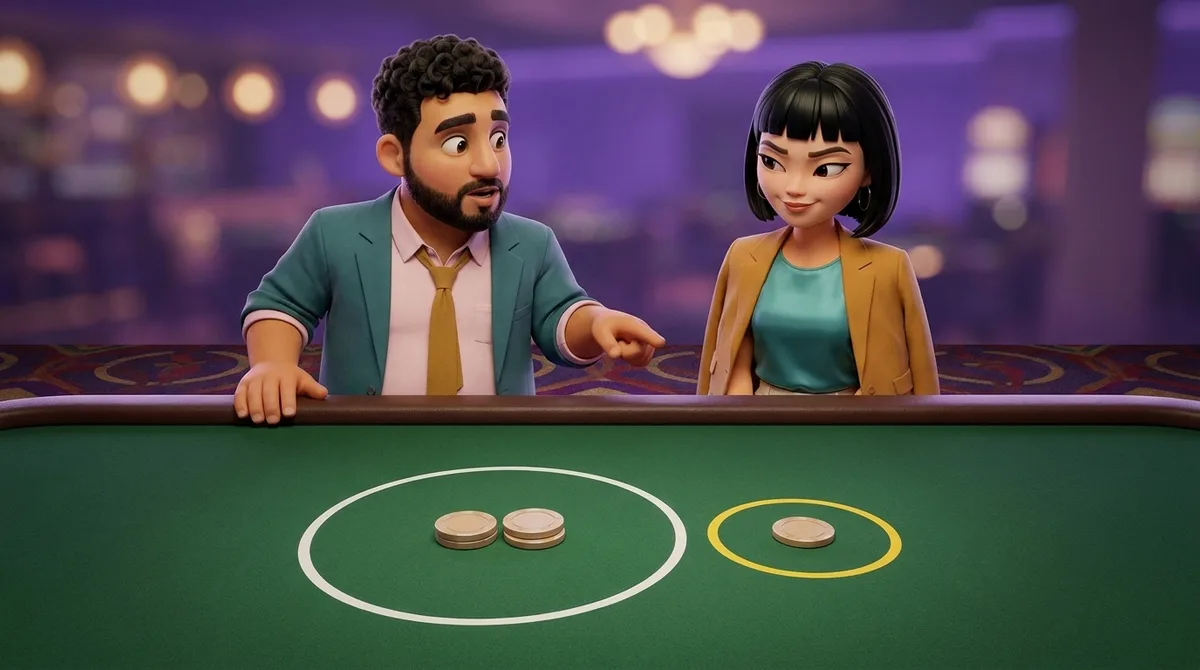
Two bets on one hand
A side bet is an extra bet on the same cards. Perfect Pairs is optional: you can bet on the hand and leave Perfect Pairs alone, and if you do want it, the chip goes down before the bet on the hand or together with it. So the side bet never comes without a bet on the hand, and it never comes after the cards.
The two chips are then settled apart. As soon as every player has a second card, the croupier goes round the Perfect Pairs bets, takes the ones that lost and pays the ones that won, and the catalogue says in so many words that the result of the pair bet has no bearing on the bet on the hand. A hand that loses can be sitting next to a pair bet that was paid, and a hand that is paid next to a pair bet that was taken.
The chip is small by rule. A Perfect Pairs bet is at least 10% of the table minimum and at most 80% of the table’s minimum blackjack bet, so at the table minimum the side bet is always the smaller chip of the two.
What the side bet pays for
The whole of a side bet is its pay table: what it asks of the cards, and what it pays when the cards do it. Perfect Pairs asks for a pair in your first two cards, and it pays for that pair three ways: a perfect pair of the same suit, a coloured pair of the same colour in two different suits, and a mixed pair of one red card and one black. On this bet the cards count as they do in the hand, except the pictures and the ace, which count by their letter: two jacks are a pair, a jack and a king are not.
- Perfect pairThe same card twice: same rank, same suit. A shoe of six decks holds six of each card.Pays 25 to 1
- Coloured pairSame rank, same colour, two different suits.Pays 15 to 1
- Mixed pairSame rank, one red card and one black card.Pays 5 to 1
- Not a pairBoth count ten in the hand, but on this bet a picture card counts by its letter, and a king is not a queen.The chip is taken
How much each kind of pair is paid and how often each kind comes out of a six-deck shoe belong together, because a pay table on its own tells you nothing about a price. Here they are in one table, counted over every two-card start a six-deck shoe can deal.
| Kind of pair | Pays | Two-card starts of this kind |
|---|---|---|
| Perfect pair | 25 to 1 | 780 |
| Coloured pair | 15 to 1 | 936 |
| Mixed pair | 5 to 1 | 1,872 |
| No pair at all | The chip is taken | 44,928 |
| Every two-card start | 48,516 |
A single bar standing for every two-card start a six-deck shoe can deal. Three thin bands on the left are the perfect pairs, the coloured pairs and the mixed pairs; the long band filling the rest of the bar is the starts that are not a pair at all.
Perfect pairsColoured pairsMixed pairsNot a pair
The bar draws the right-hand column to length: the rarer a kind of pair, the more it pays and the thinner its band.
What the side bet costs an hour
Played by the full chart, these rules leave the house a share of every bet on the hand, and every move away from the chart makes that share larger. The Perfect Pairs side bet leaves the house a share of its own, worked out from the pay table above and from the shoe the cards come out of. Here are the two shares beside each other.
| The chip goes on | Share of that chip the house keeps |
|---|---|
| The hand, played by the full chart | 0.36% |
| The Perfect Pairs side bet | 4.18% |
The share on the hand comes from the table rules of the SCJ catalogue; the share on the pair bet comes from the pay table in the same catalogue, over six decks.
A share is hard to feel, and money is not. Take an example bet of 10 units on the hand — an example, not a suggested bet — and call it the table minimum, so that the largest Perfect Pairs chip the catalogue allows beside it is 8 units. Put both on every hand for an hour at an example pace of 70 hands an hour, not a measured one, and here is what each of the two chips takes out of that hour.
The hour assumes a chip on the side bet on every hand: a smaller chip or a quieter table is another price, and so is a hand bet above the minimum.
Before a chip goes on the side bet
Three questions settle what a side bet will cost you, and all three can be answered before the cards come out: what it asks of the cards, what it pays for each kind, and how big a chip goes on how many hands. The amounts of the bets have to be posted in the room, game by game, so the smallest chip the table takes is printed where you can read it.
None of this makes a side bet a mistake, and none of it makes a side bet a plan. It is a bet on two cards with a pay table that keeps 4.18% of every chip, and the hour worked out above is what that costs. It is never a way to get back what the hand has lost: money put on the pair bet is taken faster than money put on the hand, so an hour spent chasing a loss on the side bet makes the hole deeper on average, not shallower.

Mayaformer floor supervisor · manners, money and breaks
Decide how much money the evening gets and how long it runs before you sit down, and stop when either one is used up. A run of hands that took your chips is not a debt the table owes you: putting more money down to get it back only makes the hour dearer, and the side bet makes it dearer faster than anything else on the felt. If the money on the table starts to feel like money you need, stop for the evening.
If it stops being fun
If gambling stops being fun, the SCJ self-exclusion applies in every casino in the country. Minimum entry age: 18 (age of majority under Law 19.221; Law 19.995 bars minors from gaming rooms). The casino may ask for an official ID. More on responsible gaming.
Show all regions
The pay table on one card
That is the lesson. The Perfect Pairs pay table is on one card: print it, or keep it on your phone.
| Kind of pair | Pays | Share of two-card starts |
|---|---|---|
| Perfect pair | 25 to 1 | 1.61% |
| Coloured pair | 15 to 1 | 1.93% |
| Mixed pair | 5 to 1 | 3.86% |
| No pair at all | The chip is taken | 92.60% |
Of every chip, the house keeps 4.18% on Perfect Pairs and 0.36% on the hand played by the full chart. A king and a queen are not a pair on this bet.
18+ across Chile · Set a limit before you sit · Play responsibly · the regulator’s number is on the Helplines page, in the Guides section of this site
Practice table
The table below deals hands from a shuffled shoe and checks your first decision on each hand against the chart for the rules of the catalogue. Decide with the buttons or with the keys H, S, D and R; R, surrender, is not offered against an ace. There is no money on this table: the amounts beside each decision are averages for the example bet you choose.
It deals no side bets, and that is not an omission. Once the chip is down on Perfect Pairs there is nothing left to decide: the two cards come out and the pay table settles them. The decisions a side bet does take — whether to make it, and how big a chip — are made before the chip goes down, and a dealt hand cannot practise them. What the table below practises is the other chip, the one on the hand, where a decision moves the price.
These are the rules the Superintendencia de Casinos de Juego (SCJ) sets for every casino in Chile; this table answers by the chart for those rules. The bet is only an example for the amounts shown, not a suggested bet.
Dealer
You
Lesson done
Review my mistakes (0)
Progress stays in this browser; nothing is sent anywhere.
The practice table needs JavaScript. Here is one hand from it, with the answer.
Dealer shows a 7
You hard 16
The chart says: Hit.
Hard 16 against a 7: The dealer card is strong: standing on 16 loses whenever the dealer finishes on 17 or more, 73.8% of hands against a 7.
Average result per hand on an example bet of 10 units (a minus means money lost): stand −4.77 units · hit −4.09 units. Standing instead costs about 0.68 units more each time.
Check yourself

Mayaformer floor supervisor · manners, money and breaks
Five quick ones. Pick an answer, then check it. No timer, no points: just whether it stuck.
And the question at the start
What a chip on Perfect Pairs costs is worked out from two things: what the pay table pays for each kind of pair, and how often a six-deck shoe deals one. For the catalogue’s pay table that comes to several times what the bet on the hand costs, hour for hour, even with the side-bet chip at the largest size the catalogue allows beside a bet at the table minimum.
Where to play, and further reading
18+ across Chile · Play responsibly · the help box is further up this page
Further reading
- Catálogo de Juegos (Black Jack) · Superintendencia de Casinos de JuegoThe regulator’s rules for blackjack: six decks, how the dealer plays, doubling, splitting, retiro and the seguro.
- Funcionamiento de los juegos: Juegos de cartas · Superintendencia de Casinos de JuegoThe regulator’s plain-language page on card games: which games are allowed and what equipment is approved.
How it’s worked out
Rules, numbers and hosts
Where this happens. Every table on this page is a table in a room you can walk into. The share of each bet on the hand is worked out for the blackjack rules the SCJ sets out in its national catalogue of games, and the side bet is priced from the pay table in the same catalogue. Perfect Pairs is played only at a table whose felt has a box for it.
Numbers. The share of a bet on the hand is worked out when the page is built, by our blackjack engine, assuming the full chart and, where the catalogue is silent on what a dealer blackjack takes from a double or a split, the dearer reading. The share of the pair bet is worked out from the catalogue’s pay table over every two-card start a six-deck shoe can deal, with pairs counted by rank, so that a king and a queen are not a pair. The hour is the example bet, times the example pace of hands an hour, times the share; for the side bet the chip is 80% of the example bet, the largest the catalogue allows beside a bet at the table minimum. No document we read publishes these figures; they are ours.
What is deliberately absent. There is no list of which tables in which Chilean rooms carry the Perfect Pairs box: no document we could read publishes one, and the games on a floor change. Side bets that the catalogue does not set out are not described here.
Hosts. Maya is an illustrated character. Her backstory, a former floor supervisor, is written for the course: she is not a real person and does not speak for any casino. The rules and numbers on this page come from the sources it cites, not from her experience.
No promise. Blackjack is played against the house, and a side bet is played against a pay table. Nothing on this page makes either of them free of cost, and nothing on it says how an evening will end.
Tables with the Perfect Pairs bet
Se podrá jugar con las dos variantes de la modalidad Black Jack, cuando el paño de la mesa de juego contenga los recuadros o figuras tanto para la apuesta original como para la apuesta Perfect Pairs.Free translation: Both variants of the Black Jack game may be played when the layout of the gaming table contains the boxes or figures for both the original bet and the Perfect Pairs bet.
Section III.1 Black Jack (modalidad Black Jack o Veintiuno); I. Cuestiones generales
Perfect Pairs is optional
La apuesta Perfect Pairs no es obligatoria, de tal forma que un jugador puede hacer la apuesta inicial y no realizar la apuesta Perfect Pairs, sin embargo, si decide realizarla debe hacerlo en forma previa o simultánea con la apuesta inicial.Free translation: The Perfect Pairs bet is not mandatory, so a player may place the initial bet and not place the Perfect Pairs bet; however, if they decide to place it, they must do so before or at the same time as the initial bet.
Section III.1 Black Jack (modalidad Black Jack o Veintiuno); I. Cuestiones generales
With the bet on the hand, not after it
La apuesta Perfect Pairs no es obligatoria, de tal forma que un jugador puede hacer la apuesta inicial y no realizar la apuesta Perfect Pairs, sin embargo, si decide realizarla debe hacerlo en forma previa o simultánea con la apuesta inicial.Free translation: The Perfect Pairs bet is not mandatory, so a player may place the initial bet and not place the Perfect Pairs bet; however, if they decide to place it, they must do so before or at the same time as the initial bet.
Section III.1 Black Jack (modalidad Black Jack o Veintiuno); I. Cuestiones generales
Perfect Pairs is settled on its own
Es una apuesta adicional sólo utilizada para Black Jack variante “Perfect Pairs”, en la cual el jugador apuesta a que con sus primeras dos cartas obtendrá un par de la misma pinta u otro tipo de par, donde un par corresponde a dos cartas con el mismo valor. El resultado de esta apuesta no tiene influencia sobre la apuesta inicial.Free translation: It is an additional bet used only for the Black Jack variant "Perfect Pairs", in which the player bets that with their first two cards they will obtain a pair of the same suit or another type of pair, where a pair means two cards with the same value. The result of this bet has no influence on the initial bet.
En ese momento para el Black Jack variante “Perfect Pairs”, se procede a revisar las apuestas “Perfect Pairs” realizadas, recogiendo las apuestas perdedoras y pagando las ganadoras de derecha a izquierda.Free translation: At that moment, for the Black Jack variant "Perfect Pairs", the "Perfect Pairs" bets placed are checked, collecting the losing bets and paying the winning ones from right to left.
Section III.1 Black Jack (modalidad Black Jack o Veintiuno); I. Cuestiones generales
How much may go on Perfect Pairs
El jugador que realice una apuesta Perfect Pairs debe depositar sobre el recuadro o figura del paño de la mesa definida para este tipo de apuesta, una cantidad mínima equivalente al 10% del mínimo establecido para la mesa y máxima de hasta el 80% de la apuesta mínima establecida para el Black Jack en la mesa.Free translation: A player who places a Perfect Pairs bet must place on the box or figure of the table layout defined for this type of bet a minimum amount equivalent to 10% of the minimum set for the table and a maximum of up to 80% of the minimum bet set for Black Jack at the table.
Section III.1 Black Jack (modalidad Black Jack o Veintiuno); I. Cuestiones generales
What the cards are worth in the hand
En este juego las figuras valen diez puntos, el as un punto u once, según convenga al jugador o al croupier, y las otras cartas tienen su valor nominal.Free translation: In this game the face cards are worth ten points, the ace one point or eleven, as suits the player or the dealer, and the other cards have their face value.
Section III.1 Black Jack (modalidad Black Jack o Veintiuno); I. Cuestiones generales
Three kinds of pair, and how the cards count
Las apuestas ganadoras son tres; cuando se obtiene Perfect Pairs, esto es un par de cartas con la misma pinta; Par de Color, o par de cartas del mismo color, rojo o negro, pero de diferente pinta; y Par Mezclado, o par conformado por una carta con pinta de color rojo y una con pinta de color negro.Free translation: There are three winning bets: when a Perfect Pairs is obtained, that is, a pair of cards of the same suit; Par de Color, or a pair of cards of the same color, red or black, but of a different suit; and Par Mezclado, or a pair made up of one card of a red suit and one of a black suit.
En esta opción del juego las cartas valen lo mismo que en la variante “clásico” del Black Jack, con la excepción de las figuras y el As, cuyo valor es el símbolo de cada una de ellas, esto es: J (Jota), Q (Reina), K (Rey) y A (As).Free translation: In this option of the game the cards are worth the same as in the "classic" variant of Black Jack, with the exception of the face cards and the Ace, whose value is the symbol of each of them, that is: J (Jack), Q (Queen), K (King) and A (Ace).
Section III.1 Black Jack (modalidad Black Jack o Veintiuno); I. Cuestiones generales
The Perfect Pairs pay table
Si el jugador tiene Perfect Pairs. 25 a 1Free translation: If the player has Perfect Pairs. 25 to 1
Si el jugador tiene Par de Color. 15 a 1Free translation: If the player has Par de Color. 15 to 1
Si el jugador tiene Par Mezclado. 5 a 1Free translation: If the player has Par Mezclado. 5 to 1
Section III.1 Black Jack (modalidad Black Jack o Veintiuno); I. Cuestiones generales
What the room posts
Dichos montos deberán ser informados en las salas de juego, a través de la señalización correspondiente respecto de cada juego.Free translation: Those amounts must be posted in the gaming rooms, by means of the corresponding signage for each game.
Section III.1 Black Jack (modalidad Black Jack o Veintiuno); I. Cuestiones generales
Los montos de las apuestas de cada juego deben ser informados en las salas de juego.Free translation: The bet amounts for each game must be posted in the gaming rooms.
Superintendencia de Casinos de Juego (SCJ) · Funcionamiento de los juegos: Juegos de cartas · read