Atlassino Academy · Blackjack · Lesson 17
Third base, hot tables and the table's mood
The seat at the end of the table, the table that is said to be running hot, and what a neighbour’s decision can and cannot do to your hand.
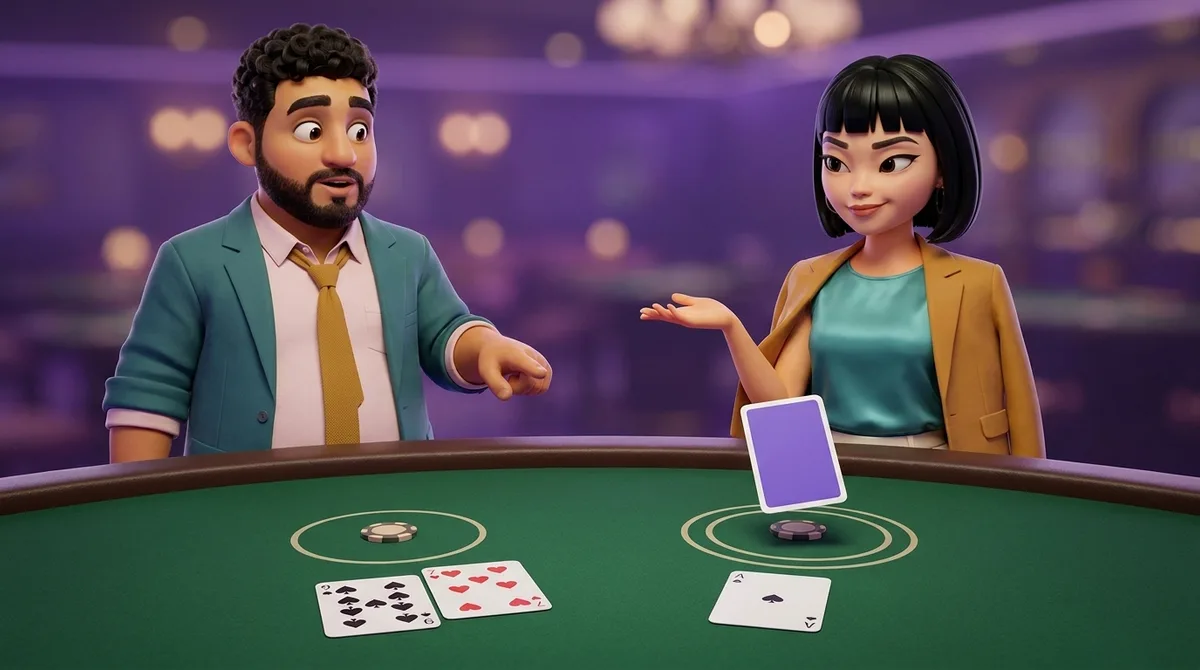
You stand on 16. The player at the last seat takes a card, the dealer makes 20, and your bet is collected. Did that seat cost you the hand?
The short answer
Nobody at a blackjack table, on either side of it, knows which card is coming out of the shoe next, so nobody at the last seat could have known what the card they took was going to do. A decision at another betting spot changes which card reaches which hand. It does not change what is sitting in the shoe, what the dealer is allowed to do with the house hand, or what your own hand is paid.
Every betting spot is settled against the dealer’s hand
A hand is dealt to every betting spot that has money in it, and each hand is settled on its own.
The money goes into the spot before the first card comes out, and a bet that is not in its spot by then is not a bet on that hand at all.
A blackjack table seen from above. The dealer stands behind the chip tray on one side. In front of the dealer, seven betting spots run in an arc, and the hands in those spots are played one after another before the dealer plays the house hand. The seventh spot is the last one to play.
- 1plays first
- 2plays second
- 3plays third
- 4plays fourth
- 5plays fifth
- 6plays sixth
- 7plays last, just before the dealer
Then every spot is settled against one thing: the dealer’s hand. A total higher than the dealer’s is paid 1 to 1, a blackjack is paid 3 to 2, a lower total goes to the house, and a hand over 21 is lost as soon as it goes over.
The last seat, and the card that moved
The spots are dealt one after another, and the dealer plays the house hand after every spot has finished. The seat that decides last, just before the dealer, is the one people call third base.
Here is what a decision at the last seat actually does. The cards come out of the shoe one after another, from the front, and that shoe holds six decks shuffled together. A card taken at the last seat is a card the dealer does not get, so the dealer’s next card comes from one place further along. That much is real: the dealer’s hand genuinely is different depending on what the last seat did.
The last seat takes a card
- 9♣of clubsgoes to the last seat
- 4♥of heartsgoes to the dealer
- 7♠of spadesstays in the shoe
The last seat stands
- 9♣of clubsgoes to the dealer
- 4♥of heartsstays in the shoe
- 7♠of spadesstays in the shoe
What is missing from the blame is the part nobody can supply. Before either card came out, no one at that table could have named it — not the player at the last seat, not you, and not the dealer. So the sentence “you took my card” is said about a card that had no owner and no name until it was face up, and it is a complaint that can only be made backwards.
A dealer with no choices to make
A table gets called hot or cold, and the dealer gets called hot or cold along with it. The trouble with calling a dealer anything is that a dealer makes no decisions at all: the house hand is drawn on any total of 16 or less and stopped on every 17 or more, hand after hand, against every spot at the table. What a hand turns into is in the cards that came out of the shoe, and not in the dealer dealing that hand.
| The dealer’s own total | What the dealer does with it |
|---|---|
| 16 or less | takes another card |
| 17 or more — with an ace counted as eleven or without one | stops there |
| Changes from hand to hand | Does not change all evening |
|---|---|
| Which cards come out of the shoe, and which spot each one reaches | How many decks are shuffled together in that shoe: six |
| Which betting spots have money in them, and how much | What a hand is paid: 1 to 1, a blackjack 3 to 2 |
| How the hand you are holding adds up | The rule the dealer draws and stops by, against every spot |
| How many people are sitting at the table | That nobody at it knows what card is coming next |
The first three rows of the right-hand column are printed in the rulebook, where you can read them before your first hand; the last one is how a shuffled shoe works. Everything in the left-hand column is what the evening does, and none of it is knowable in advance.
Whose decision it is
All of which leaves a practical question: when a neighbour is sure what you should do with your 16, how much does that count?
The rulebook answers it in two sentences. A player may not play another player’s hand, and may not interfere in another player’s decision to stand, split, double, insure or take the retiro. A neighbour can talk; the decision stays where the money is.

Mayaformer floor supervisor · manners, money and breaks
One last thing, and it matters more than anything else I have said here. Decide how much money the evening gets and how long it runs before you sit down, and stop when the money is gone or the time is up, whichever comes first. A run of hands going against you is not a debt the table owes you: putting more money down to get it back only makes the hour dearer, and the card that comes next is as unknown as it was an hour ago.
If the money on the table starts to feel like money you need, or you are playing to get away from something, stop there and read the box below: it says where self-exclusion and the regulator are reached.
If it stops being fun
If gambling stops being fun, the SCJ self-exclusion applies in every casino in the country. Minimum entry age: 18 (age of majority under Law 19.221; Law 19.995 bars minors from gaming rooms). The casino may ask for an official ID. More on responsible gaming.
Show all regions
Practice table
The practice table deals hands from a shuffled shoe and checks your first decision on each hand against the chart for the rules of the catalogue of games. Decide with the buttons or with the keys H, S, D and R. There is no money on this table: the amounts it prints for each decision are averages for the example bet you choose.
What it practises is your own hand, because that is the only thing at a blackjack table you decide. There is no drill here for a neighbour’s decision, and there cannot be one: a decision at another spot leaves you nothing to practise.
These are the rules the Superintendencia de Casinos de Juego (SCJ) sets for every casino in Chile; this table answers by the chart for those rules. The bet is only an example for the amounts shown, not a suggested bet.
Dealer
You
Lesson done
Review my mistakes (0)
Progress stays in this browser; nothing is sent anywhere.
The practice table needs JavaScript. Here is one hand from it, with the answer.
Dealer shows a 7
You hard 16
The chart says: Hit.
Hard 16 against a 7: The dealer card is strong: standing on 16 loses whenever the dealer finishes on 17 or more, 73.8% of hands against a 7.
Average result per hand on an example bet of 10 units (a minus means money lost): stand −4.77 units · hit −4.09 units. Standing instead costs about 0.68 units more each time.
Check yourself

Mayaformer floor supervisor · manners, money and breaks
Five quick ones. Pick an answer, then check it. No timer, no points: just whether it stuck.
Where to play
18+ across Chile · Play responsibly · the help box is further up this page
How it’s worked out
Rules, numbers and hosts
Rules. The rules on this page are those of the national catalogue of games that the Superintendencia de Casinos de Juego (SCJ) sets for every casino in Chile: six decks, the dealer stopping on every 17, blackjack paid 3 to 2, and every card dealt face up, the dealer’s second card after the players. It is a preset for learning, not a statement about any one casino.
Numbers. The share of a bet the house keeps is worked out when the page is built, by our blackjack engine, for those rules. It assumes the full chart — hard totals, soft hands, pairs and the retiro — and cards shuffled after every hand. The catalogue does not say whether a dealer blackjack also takes a double or a split; the figure assumes that it does, the costlier reading.
A habit without a figure. There is no figure here for playing every hand as though the dealer’s second card were going to be a ten. Our engine works out a chart, not a habit, so the page names the habit and does not price it.
What is deliberately absent. There is no figure here for how often a decision at one betting spot changes the result at another, no figure for how often a dealer’s hand ends one way after a card has moved, and no count of hands at a table: a figure our own engine cannot recompute does not go on a page. The seat at the end of the table is described by when it plays: the catalogue deals the cards spot by spot, starting at the dealer’s left and going clockwise.
The practice table. It is the blackjack practice table used across this track, and it drills the chart. A drill of its own for this lesson would have to deal a neighbour’s decision and then ask what it changed, and the honest answer would be the same every time.
Hosts. Maya is an illustrated character. Her backstory, a former floor supervisor, is written for the course: she is not a real person and does not speak for any casino. The rules and numbers on this page come from the sources it cites, not from her experience.
No promise. Blackjack is played against the house. Nothing on this page makes the game cost nothing, and nothing on it says how an evening will end.
The order of a hand
Cuando se hayan efectuado todas las apuestas el croupier distribuye una carta a cada mano, comenzando por su izquierda y siguiendo el sentido de las agujas del reloj. Luego el mismo se da una carta.Free translation: When all the bets have been placed, the dealer deals one card to each hand, starting from his left and proceeding clockwise. Then he deals himself a card.
Después se distribuye una segunda carta a cada mano de los jugadores, siempre en el mismo orden.Free translation: Then a second card is dealt to each player's hand, always in the same order.
Section III.1 Black Jack (modalidad Black Jack o Veintiuno); I. Cuestiones generales
What a hand is paid
Si el jugador hace un juego diferente a Black Jack 1 a 1 (a la par)Free translation: If the player makes a hand other than Black Jack, 1 to 1 (even money)
Section III.1 Black Jack (modalidad Black Jack o Veintiuno); I. Cuestiones generales
A hand over 21
Cuando una mano obtiene una puntuación superior a 21 pierde, el croupier recoge inmediatamente esa apuesta y las cartas antes de pasar a la mano siguiente, en que se procede de la misma forma.Free translation: When a hand obtains a score above 21 it loses, and the dealer immediately collects that bet and the cards before moving on to the next hand, which is handled in the same way.
Section III.1 Black Jack (modalidad Black Jack o Veintiuno); I. Cuestiones generales
What the game is played for
El Black Jack es un juego de cartas cuyo objeto es alcanzar veintiún puntos o acercarse a ellos sin pasar de este límite. Los participantes juegan a ganarle al croupier y no necesariamente a obtener veintiún puntos.Free translation: Black Jack is a card game whose object is to reach twenty-one points or get close to them without going over this limit. The participants play to beat the dealer and not necessarily to obtain twenty-one points.
Section III.1 Black Jack (modalidad Black Jack o Veintiuno); I. Cuestiones generales
Six decks
Para la modalidad Black Jack se usarán 6 barajas de 52 cartas cada una, tres de un color y tres de otroFree translation: For the Black Jack variant, 6 decks of 52 cards each will be used, three of one color and three of another
Section III.1 Black Jack, 1.4.1 Barajas
What a hand is paid
Si el jugador hace un juego diferente a Black Jack 1 a 1 (a la par)Free translation: If the player makes a hand other than Black Jack, 1 to 1 (even money)
Section III.1 Black Jack (modalidad Black Jack o Veintiuno); I. Cuestiones generales
Si el jugador hace Black Jack 1 a 1 (a la par) 1a1 3a2Free translation: If the player makes Black Jack, 1 to 1 (even money) 1a1 3a2
Section III.1 Black Jack, Pago de apuestas, a) General
The dealer has no choices
Con 17 puntos o más Debe plantarse, es decir, no pedir carta adicionalFree translation: With 17 points or more, must stand, that is, not ask for an additional card
Con 16 puntos o menos Debe tomar más cartas hasta que el total de su puntuación alcance 17 o másFree translation: With 16 points or fewer, must take more cards until the total score reaches 17 or more
Section III.1 Black Jack (modalidad Black Jack o Veintiuno); I. Cuestiones generales
Where a bet goes, and when
Antes de que se distribuya carta alguna el croupier invita a los jugadores a apostar. Los jugadores hacen sus apuestas colocando el importe de las mismas en fichas en el punto de apuesta marcado en el paño.Free translation: Before any card is dealt, the dealer invites the players to bet. Players make their bets by placing the amount of them in chips on the betting spot marked on the layout.
Las apuestas rechazadas por el croupier, después del “no más apuestas”, no tendrán valor, cualquiera que sea su monto, quedando nulas.Free translation: Bets rejected by the dealer after "no more bets" shall have no value, whatever their amount, and are void.
Section III.1 Black Jack (modalidad Black Jack o Veintiuno); I. Cuestiones generales
What a hand is paid, and what a hand over 21 costs
Si el jugador hace un juego diferente a Black Jack 1 a 1 (a la par)Free translation: If the player makes a hand other than Black Jack, 1 to 1 (even money)
Section III.1 Black Jack (modalidad Black Jack o Veintiuno); I. Cuestiones generales
Si el jugador hace Black Jack 1 a 1 (a la par) 1a1 3a2Free translation: If the player makes Black Jack, 1 to 1 (even money) 1a1 3a2
Section III.1 Black Jack, Pago de apuestas, a) General
Cuando una mano obtiene una puntuación superior a 21 pierde, el croupier recoge inmediatamente esa apuesta y las cartas antes de pasar a la mano siguiente, en que se procede de la misma forma.Free translation: When a hand obtains a score above 21 it loses, and the dealer immediately collects that bet and the cards before moving on to the next hand, which is handled in the same way.
Section III.1 Black Jack (modalidad Black Jack o Veintiuno); I. Cuestiones generales
The order of a hand
Cuando se hayan efectuado todas las apuestas el croupier distribuye una carta a cada mano, comenzando por su izquierda y siguiendo el sentido de las agujas del reloj. Luego el mismo se da una carta.Free translation: When all the bets have been placed, the dealer deals one card to each hand, starting from his left and proceeding clockwise. Then he deals himself a card.
Después se distribuye una segunda carta a cada mano de los jugadores, siempre en el mismo orden.Free translation: Then a second card is dealt to each player's hand, always in the same order.
Section III.1 Black Jack (modalidad Black Jack o Veintiuno); I. Cuestiones generales
Six decks
Para la modalidad Black Jack se usarán 6 barajas de 52 cartas cada una, tres de un color y tres de otroFree translation: For the Black Jack variant, 6 decks of 52 cards each will be used, three of one color and three of another
Section III.1 Black Jack, 1.4.1 Barajas
The dealer rule
Con 17 puntos o más Debe plantarse, es decir, no pedir carta adicionalFree translation: With 17 points or more, must stand, that is, not ask for an additional card
Con 16 puntos o menos Debe tomar más cartas hasta que el total de su puntuación alcance 17 o másFree translation: With 16 points or fewer, must take more cards until the total score reaches 17 or more
Section III.1 Black Jack (modalidad Black Jack o Veintiuno); I. Cuestiones generales
Considerando que el croupier saca cartas con 16 puntos o menos y se planta con 17 puntosFree translation: Considering that the dealer draws cards with 16 points or fewer and stands on 17 points
Cuando el croupier tiene un as entre sus cartas, debe contarlo como once (11) puntos si con este valor alcanza 17 o másFree translation: When the dealer has an ace among his cards, he must count it as eleven (11) points if with this value he reaches 17 or more
Section III.1 Black Jack, Pedida de cartas
Where the dealer’s second card is
Cuando se hayan efectuado todas las apuestas el croupier distribuye una carta a cada mano, comenzando por su izquierda y siguiendo el sentido de las agujas del reloj. Luego el mismo se da una carta.Free translation: When all the bets have been placed, the dealer deals one card to each hand, starting from his left and proceeding clockwise. Then he deals himself a card.
Section III.1 Black Jack (modalidad Black Jack o Veintiuno); I. Cuestiones generales
Cuando se hayan efectuado todas las apuestas el croupier distribuye una carta a cada mano, comenzando por su izquierda y siguiendo el sentido de las agujas del reloj. Luego el mismo se da una carta.Free translation: When all the bets have been placed, the dealer deals one card to each hand, starting from his left and proceeding clockwise. Then he deals himself a card.
Todas las cartas se distribuyen siempre descubiertas.Free translation: All cards are always dealt face up.
Una vez que los jugadores han hecho su juego, el croupier termina su mano, dándose a sí mismo una o varias cartasFree translation: Once the players have made their play, the dealer finishes his hand, giving himself one or several cards
Section III.1 Black Jack, Distribución de cartas; a) Juego simple
Who decides the hand at a betting spot
Un jugador no puede jugar la mano de otro.Free translation: A player may not play another player's hand.
No pueden interferir en la decisión de otro jugador (plantarse, abrir, doblar, asegurarse o retirarse),Free translation: They may not interfere in another player's decision (to stand, open, double down, take insurance or fold),
Section III.1 Black Jack (modalidad Black Jack o Veintiuno); I. Cuestiones generales