Atlassino Academy · Blackjack · Lesson 5
Why you act first, and what it costs
Where the house edge in blackjack comes from, priced hand by hand for the table rules the Superintendencia de Casinos de Juego (SCJ) sets for every casino in Chile.
A lesson of the blackjack track. How a hand goes, and what hit, stand, double and split do to it, is taken for granted here. It teaches none of those moves. Underneath all of those moves sits one question: where does the price of blackjack come from, and how big is it?
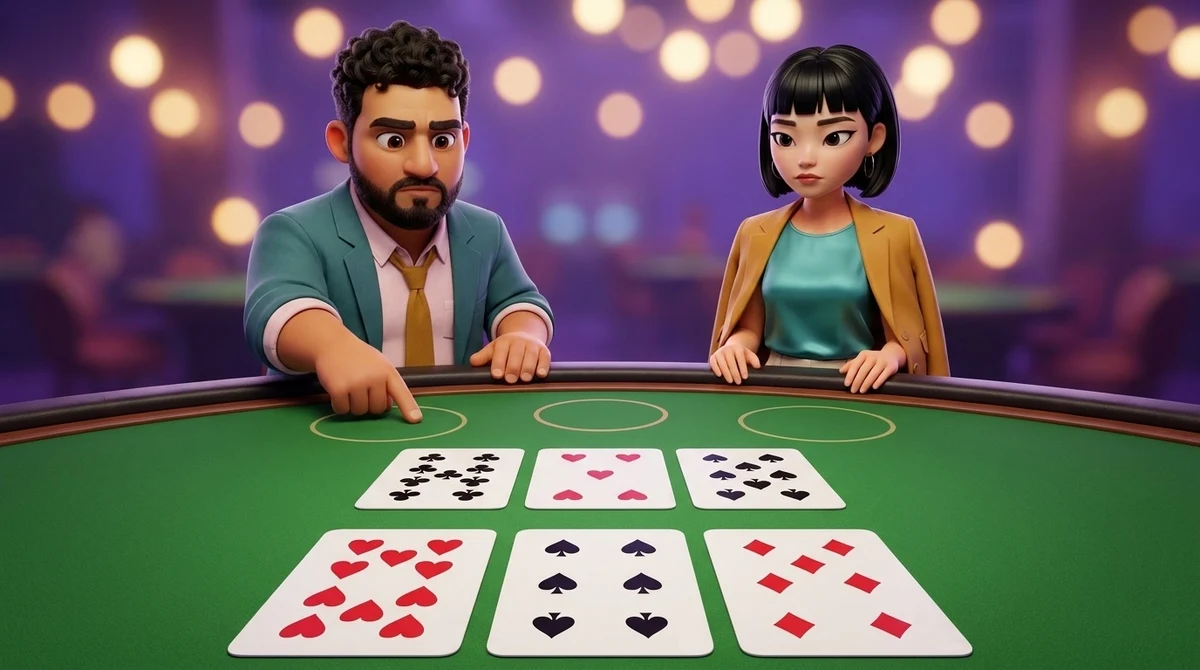
The dealer’s face-up card is a 6, the card the dealer goes over 21 behind more often than any other. You hold a hard 16. On an example bet of 10 units, what is your hand worth on average?
Dealer
You
The short answer
You play your own hand before the dealer plays the house hand, and a total over 21 is lost before the dealer plays — so once your own total has gone over 21, the 28.2% of hands where the dealer goes over 21 arrive a turn too late to pay you anything. The five things the table lets you do and the dealer may not are the payment for going first, and under Chile’s rules that payment falls short of the bill: played by the full chart, the house keeps 0.36% of every bet.

Leoformer dealer · rules and maths
The question players asked me most, in all those years dealing: how is the house ahead at a game where the dealer has no skill at all? The answer is the order of play. The dealer needs no skill because the dealer goes last, and going last is worth more at this game than any decision is. So we will walk through a hand in the order a hand actually happens at the table.
The order of a hand, and what it settles
A hand of blackjack in Chile happens in the same four steps, and the price of the game is hidden in the order of those four steps rather than in any one of them.
You play your hand first
Every player gets a card, the dealer takes one, and every player gets a second card; then each player in turn asks for cards or stops. Every card is dealt face up, and the dealer has a single card on the felt while you decide.
Over 21, and the bet is gone
A total over 21 is lost on its own: the dealer picks up the bet and the cards at once, before moving on to the next hand.
Then the dealer plays the house hand
The dealer takes a second card, draws on any total of 16 or less, and stops on every 17 or more — the same line on every hand, against every player.
Or stops short
When the dealer’s card is under 10 and only blackjacks are left on the table, the dealer takes no more cards and pays them; and a dealer who goes over 21 pays every bet still on the felt.
So the hands where you go over 21 and the dealer goes over 21 as well belong to the house. The rulebook says it in its own way: a dealer over 21 pays the bets that are still on the felt. Your bet is not on the felt any more — it left the table a turn earlier.
Dealer
You
One more thing comes after you have played: the dealer’s second card. A dealer blackjack shows itself only when that card is dealt, and what it then takes from a second bet or a split the rulebook does not say; the figures on this page take the costlier reading, that it takes every bet on your hand. A dealer showing a 10 makes blackjack on 7.7% of hands, and a dealer showing an ace on 30.9%.
How often the dealer goes over 21
How often the dealer goes over 21 is the number players lean on at the table, and it is a real number. Played out across a whole shoe, the house hand goes over 21 on 28.2% of hands — about one hand in 3.5. The dealer does not go over 21 as often behind every card, though: almost all of the difference hangs on which card the dealer has face up, and that face-up card is the only card of the dealer’s you can read before you decide anything.
| Dealer shows | 17 | 18 | 19 | 20 | 21 | Blackjack | Over 21 |
|---|---|---|---|---|---|---|---|
| Weak cards: 2 to 6 | |||||||
| 2 | 14.0 | 13.4 | 13.0 | 12.4 | 11.8 | – | 35.4 |
| 3 | 13.4 | 13.1 | 12.5 | 12.1 | 11.5 | – | 37.4 |
| 4 | 13.1 | 12.4 | 12.1 | 11.6 | 11.2 | – | 39.6 |
| 5 | 12.2 | 12.2 | 11.8 | 11.2 | 10.8 | – | 41.8 |
| 6 | 16.6 | 10.6 | 10.6 | 10.2 | 9.7 | – | 42.3 |
| Strong cards: 7 to ace | |||||||
| 7 | 36.9 | 13.8 | 7.8 | 7.9 | 7.4 | – | 26.2 |
| 8 | 12.9 | 36.0 | 12.9 | 6.9 | 6.9 | – | 24.4 |
| 9 | 12.0 | 11.7 | 35.2 | 12.0 | 6.1 | – | 22.9 |
| 10 | 11.2 | 11.2 | 11.2 | 34.0 | 3.5 | 7.7 | 21.2 |
| Ace | 13.0 | 13.1 | 13.1 | 13.1 | 5.4 | 30.9 | 11.5 |
Only the dealer’s face-up card changes from row to row. The six decks and the dealer rule are the same in every row, and the bar in the last column is the share of hands that end over 21 behind that one card.
- Behind a 7, an 8, a 9, a ten or an ace the house hand goes over 21 on 11.5% to 26.2% of hands — and one of those five cards is the face-up card 61.5% of the time.
- Behind a 2, 3, 4, 5 or 6 the house hand goes over 21 on 35.4% to 42.3% of hands. Far more often, that is, and on the smaller share of the deals: the dealer is in trouble much less often than a table full of players feels it to be.
The dealer going over 21 never reaches a hand that has already been lost. That is the whole asymmetry of blackjack in one sentence. How often the dealer goes over 21 is counted with the house hand played out to the rule on every deal, and by the time a dealer does play it, some of the bets on the table have already been picked up — yours among them, on every hand where your own total went over 21 first.
Two rows, one above the other. In the upper row your own ten, six and nine make twenty-five, and the bet in front of those three cards is picked up. In the lower row, a turn later, the dealer draws to twenty-five as well, and the bet from the upper row is no longer on the table.
The hands that can go over 21 are yours to play first
Going first would cost you nothing at all if your own hand could not go over 21. Your hand can go over 21, and a great many starting hands are one card away from it — while a starting total of eleven or less cannot be taken over 21 by any single card, because the largest card in the deck is a ten.
A hard 12 to 16 meets a dealer’s 7 or better more often than not — the hand where the choice costs you either way, decided before the dealer decides anything.

Leoformer dealer · rules and maths
Here is the part that surprises people. Take the friendliest spot on the whole table: the dealer’s face-up card is a 6, the card the dealer goes over 21 behind more often than any other, and you are already finished on a hard 17. There is nothing left for you to decide on that hand. Watch how little the hand is worth anyway.
Dealer
You
A finished hard 17 against a 6 is worth almost exactly nothing — a fraction above it, on a hand you cannot play badly because there is nothing left to play. Three things can become of the bet on it, and there is no fourth:
| The dealer ends | Share | Your bet |
|---|---|---|
| over 21 | 42.3% | is paid |
| on 17, level with you | 16.6% | comes back |
| on 18 or better | 41.1% | goes to the house |
The dealer going over 21 pays this hand, and a finish of 18 or better takes the bet away — and those two shares come out nearly level, behind the dealer’s weakest card, on a hand with nothing whatever wrong with it. That near balance is what going first costs you on your strongest hands.
| Your hard total | If you stop | If you take a card |
|---|---|---|
| 16 | −1.58 units | −4.25 units |
| 17 | +0.08 units | −5.05 units |
| 18 | +2.81 units | −6.04 units |
The hard 16 in the first row is the hand you were asked about before we started; only from 17 up does stopping average more than nothing. A plus sign means this hand is in your favour on average; it can still lose, and over all hands the house keeps its edge.
A hard 16 against a 6 is not a special case. From hard 12 up to hard 16, against every one of the ten cards the dealer can show — fifty hands in all — no move averages more than nothing, the retiro included, and a hard 17 gets above nothing against a 6 alone. Picking the smaller of two losses is the whole job on those hands, and that job is what the next lessons of the track are for, starting with hard totals.
What the table gives you back
A game built on nothing but that order of play would be unplayable, and nobody would sit down at it twice. So the rules of the table hand some things back to your seat, and the dealer gets none of them. Under Chile’s rules there are five.
| At your seat | You | The dealer |
|---|---|---|
| Two cards to 21 | paid 3 to 2 — half as much again as any other hand of yours that is paid | takes the bets and no more: the house is never paid odds |
| A second bet | as much again on two cards that make 9, 10 or 11, for exactly one more card | never |
| A pair | taken apart into two hands, and again, up to four hands | plays the same two cards as one hand |
| The right to stop | stand on 12 to 16 — the plainest of the five, and the easiest to miss | must draw to 16 |
| The retiro | give the hand up for half the bet, after your first two cards, unless the dealer’s card is an ace | plays every hand out |
The retiro is taken on your turn, after your first two cards and before the dealer’s second card.
Which is why playing your own hand the way the dealer is obliged to play the house hand is not a neutral habit. Copying the dealer hands four of those five things straight back to the house: no second bet, no split, no retiro and no stopping on a hard 16 — a blackjack of your own paid at three to two is the only one of the five that survives the habit. The hand is yours to play: another player may not play it, nor interfere in your decision to stand, split, double, insure or take the retiro.
| The habit | What it does to every hand |
|---|---|
| Never going over 21 | Never take a card that could take the hand over 21, which means stopping on every hard 12 or more, whatever the dealer’s face-up card is. |
| Playing like the dealer | Play your own hand by the rule the dealer follows: draw to 16, stop on 17, and use neither the second bet, nor the split, nor the retiro. |
| Assuming a ten | Play every hand as though the dealer’s second card, still in the shoe, were already a ten, whatever the face-up card is. |
The three habits differ only in what the player settles on before the cards come out: that the hand must never go over 21, that the dealer’s rule is the right rule, or that the dealer’s second card will be a ten. Playing like the dealer is the middle habit of the three, and the only one of the three with a price on it in the practice table further on.
Played by the full chart, these rules still leave the house 0.36% of every bet. The house keeps its edge; the chart only makes it smaller — the correct move cannot decide how a hand ends; what it lowers is the house advantage and the cost of playing. Neither that share nor any amount on this page is what one evening will do: a single evening lands a long way from an average in either direction.

Mayaformer floor supervisor · manners, money and breaks
The price follows the number of hands, and the number of hands follows how long you sit. So the one decision that moves the price most is made before the first card is dealt: how long you are staying, and how much money the evening gets. Settle how long and how much before you sit down, or the shoe will settle both for you.
And if the money on the table starts to feel like money you need, no arithmetic on this page is the thing to reach for. Stop there, and read the box below: it says where self-exclusion and the regulator are reached.
If it stops being fun
If gambling stops being fun, the SCJ self-exclusion applies in every casino in the country. Minimum entry age: 18 (age of majority under Law 19.221; Law 19.995 bars minors from gaming rooms). The casino may ask for an official ID. More on responsible gaming.
Show all regions
Practice: play like the dealer?
Ten hands, and the same question on each one: play the hand the way the dealer is obliged to, or use what the table gives you? Each move is named for you, because choosing between moves yourself is what the later lessons of the track are for. What these hands price is the difference between the dealer’s rule and the table’s move, on an example bet of 10 units, under Chile’s table rules.
Nothing is scored here and there is no level to open: on all the hands but one the answer is the same, and a score would only measure how quickly you noticed that. The hand worth slowing down for is the hard 12 against a 7 — on that hand the dealer’s rule and the chart ask for exactly the same card, and both answers count.
Lesson done
Review my mistakes (0)
Progress stays in this browser; nothing is sent anywhere.
The practice table needs JavaScript. Here is one hand from it, with the answer.
These table rules · six decks · the dealer stops on every 17 · a double on 9, 10 or 11 · splits up to four hands · retiro, except against an ace
Dealer
You
The dealer has no choice on any hand: draw on 16 or less, stop on every 17 or more — never double, never split, never give up half. Play your hand that way, or use what the table gives you?
The answer: Use what the table gives you: stop on 16.
The dealer may not stop on 16; you may. On an example bet of 10 units, stopping on this hand is worth −1.58 units a hand on average and taking a card −4.25 units, so playing it the dealer’s way costs 2.67 units every time. Both amounts are below nothing: the right to stop makes the loss smaller, it does not turn the hand around.
Con 17 puntos o más Debe plantarse, es decir, no pedir carta adicionalFree translation: With 17 points or more, must stand, that is, not ask for an additional card
Con 16 puntos o menos Debe tomar más cartas hasta que el total de su puntuación alcance 17 o másFree translation: With 16 points or fewer, must take more cards until the total score reaches 17 or more
Superintendencia de Casinos de Juego (SCJ) · Catálogo de Juegos que podrán desarrollarse en los casinos de juego (texto de marzo 2023) · section III.1 Black Jack (modalidad Black Jack o Veintiuno); I. Cuestiones generales · readThe other hands work the same way: the same question, another hand, and every amount worked out by the same engine that priced the hard 16 against a 6 further up.
How the practice table works
The hands. All of them are fixed, not dealt: each one is a position where the dealer’s rule and the chart for these table rules part company, plus one where they agree. The amounts are the average result of each move over every two-card hand of that total, from the same engine that works out the tables on this page, and a cost is the difference between two amounts already rounded to the hundredth — so the subtraction on the screen comes out.
No score. There is no round, no threshold and no level: this table is a price list in the shape of a hand, not a test. Your mistakes are not kept, and nothing is sent anywhere.
The example bet. Every amount is for an example bet of 10 units. It is an example, not a suggested bet; at a bet twice as large each amount is twice as much. There is no balance here and nothing adds up from one hand to the next.
Check yourself

Mayaformer floor supervisor · manners, money and breaks
Five quick ones. Pick an answer, then check it. No timer, no points: just whether it stuck.
And the question at the start
Less than nothing, whichever way you play it — the third of the three answers. A hard 16 against a 6 is worth −1.58 units on an example bet of 10 units if you stop and −4.25 units if you take a card: both amounts are below nothing, and the better of the two is only the smaller loss. A 6 really is the card the dealer goes over 21 behind most often, on 42.3% of those hands, and that is still not enough to make the hand worth having — because you had to play your hand first, and most of the shoe takes a hard 16 over 21. That is the whole lesson in one hand.
Where this is played, and further reading
18+ across Chile · Play responsibly · the help box is further up this page
Further reading
- Catálogo de Juegos (Black Jack) · Superintendencia de Casinos de JuegoThe regulator’s rules for blackjack: six decks, how the dealer plays, doubling, splitting, retiro and the seguro.
- Funcionamiento de los juegos: Juegos de cartas · Superintendencia de Casinos de JuegoThe regulator’s plain-language page on card games: which games are allowed and what equipment is approved.
How it’s worked out
Rules, numbers and hosts
Rules. The figures on this page follow the national catalogue of games that the Superintendencia de Casinos de Juego (SCJ) sets for every casino in Chile: six decks, the dealer stopping on every 17, blackjack paid 3 to 2, a double on a two-card 9, 10 or 11, splits up to four hands, the retiro for half the bet except against an ace, and every card dealt face up, the dealer’s second card after the players. The catalogue does not say whether a dealer blackjack also takes a second bet or a split; the figures assume that it does, the costlier reading. It is a preset for learning, not a statement about any one casino.
Numbers. Every figure on this page is worked out when the page is built, by our blackjack engine. The dealer’s table goes through every order in which the dealer’s cards can come out of a six-deck shoe with the face-up card removed, and plays the house hand out to the rule every time. The 28.2% figure weights those ten face-up cards by how often each comes out of a full shoe; your own two cards are not taken out, so with them in view the figures shift slightly. The value of a hand is the average result of that move over every two-card hand of the total, per bet, shown for an example bet of 10 units, each average rounded to the hundredth first, so a cost is always the difference of two amounts shown. Against a 10 or an ace the averages include the hands where the dealer makes a blackjack, because at these tables that card comes after you play. The house edge assumes the full chart, soft hands and pairs included, and cards shuffled after every hand.
What is deliberately absent. There is not one cell of the strategy chart on this page: when to take a card and when to stop is the subject of the lessons that follow this one, and this page prices the order of play instead. There is no price of an hour, because no document we could read gives a number of hands an hour for these tables, and there is no figure here for how an evening ends either, because nothing on this page can produce one.
Hosts. Leo and Maya are illustrated characters. Their backstories, a former dealer and a former floor supervisor, are written for the course: neither is a real person, and neither speaks for any casino. The rules and numbers on this page come from the sources it cites, not from their experience.
No promise. Blackjack is played against the house. Everything on this page is about the size of the price and where it comes from; nothing here says the game can be played at no cost, and nothing here says how an evening will end.
Going over 21
Cuando una mano obtiene una puntuación superior a 21 pierde, el croupier recoge inmediatamente esa apuesta y las cartas antes de pasar a la mano siguiente, en que se procede de la misma forma.Free translation: When a hand obtains a score above 21 it loses, and the dealer immediately collects that bet and the cards before moving on to the next hand, which is handled in the same way.
Section III.1 Black Jack (modalidad Black Jack o Veintiuno); I. Cuestiones generales
The order of a hand
Cuando se hayan efectuado todas las apuestas el croupier distribuye una carta a cada mano, comenzando por su izquierda y siguiendo el sentido de las agujas del reloj. Luego el mismo se da una carta.Free translation: When all the bets have been placed, the dealer deals one card to each hand, starting from his left and proceeding clockwise. Then he deals himself a card.
Después se distribuye una segunda carta a cada mano de los jugadores, siempre en el mismo orden.Free translation: Then a second card is dealt to each player's hand, always in the same order.
Section III.1 Black Jack (modalidad Black Jack o Veintiuno); I. Cuestiones generales
Splitting a pair
Cuando un jugador recibe las dos primeras cartas del mismo valor, puede jugar "a dos manos".Free translation: When a player receives the first two cards of the same value, he may play "two hands".
pudiendo ejercerse la referida opción hasta un máximo de 3 veces, es decir, pudiendo jugar un máximo de 4 manos.Free translation: the said option may be exercised up to a maximum of 3 times, that is, allowing a maximum of 4 hands to be played.
Section III.1 Black Jack (modalidad Black Jack o Veintiuno); I. Cuestiones generales
pudiendo ejercerse la referida opción hasta un máximo de 3 veces, es decir, pudiendo jugar un máximo de 4 manos.Free translation: the said option may be exercised up to a maximum of 3 times, that is, allowing a maximum of 4 hands to be played.
Section III.1 Black Jack, d) Los pares
The dealer’s second card
Cuando se hayan efectuado todas las apuestas el croupier distribuye una carta a cada mano, comenzando por su izquierda y siguiendo el sentido de las agujas del reloj. Luego el mismo se da una carta.Free translation: When all the bets have been placed, the dealer deals one card to each hand, starting from his left and proceeding clockwise. Then he deals himself a card.
Todas las cartas se distribuyen siempre descubiertas.Free translation: All cards are always dealt face up.
Una vez que los jugadores han hecho su juego, el croupier termina su mano, dándose a sí mismo una o varias cartasFree translation: Once the players have made their play, the dealer finishes his hand, giving himself one or several cards
Section III.1 Black Jack, Distribución de cartas; a) Juego simple
The order of a hand
Cuando se hayan efectuado todas las apuestas el croupier distribuye una carta a cada mano, comenzando por su izquierda y siguiendo el sentido de las agujas del reloj. Luego el mismo se da una carta.Free translation: When all the bets have been placed, the dealer deals one card to each hand, starting from his left and proceeding clockwise. Then he deals himself a card.
Después se distribuye una segunda carta a cada mano de los jugadores, siempre en el mismo orden.Free translation: Then a second card is dealt to each player's hand, always in the same order.
Section III.1 Black Jack (modalidad Black Jack o Veintiuno); I. Cuestiones generales
The dealer’s second card
Cuando se hayan efectuado todas las apuestas el croupier distribuye una carta a cada mano, comenzando por su izquierda y siguiendo el sentido de las agujas del reloj. Luego el mismo se da una carta.Free translation: When all the bets have been placed, the dealer deals one card to each hand, starting from his left and proceeding clockwise. Then he deals himself a card.
Todas las cartas se distribuyen siempre descubiertas.Free translation: All cards are always dealt face up.
Una vez que los jugadores han hecho su juego, el croupier termina su mano, dándose a sí mismo una o varias cartasFree translation: Once the players have made their play, the dealer finishes his hand, giving himself one or several cards
Section III.1 Black Jack, Distribución de cartas; a) Juego simple
Going over 21
Cuando una mano obtiene una puntuación superior a 21 pierde, el croupier recoge inmediatamente esa apuesta y las cartas antes de pasar a la mano siguiente, en que se procede de la misma forma.Free translation: When a hand obtains a score above 21 it loses, and the dealer immediately collects that bet and the cards before moving on to the next hand, which is handled in the same way.
Section III.1 Black Jack (modalidad Black Jack o Veintiuno); I. Cuestiones generales
The dealer has no choices
Con 17 puntos o más Debe plantarse, es decir, no pedir carta adicionalFree translation: With 17 points or more, must stand, that is, not ask for an additional card
Con 16 puntos o menos Debe tomar más cartas hasta que el total de su puntuación alcance 17 o másFree translation: With 16 points or fewer, must take more cards until the total score reaches 17 or more
Section III.1 Black Jack (modalidad Black Jack o Veintiuno); I. Cuestiones generales
Considerando que el croupier saca cartas con 16 puntos o menos y se planta con 17 puntosFree translation: Considering that the dealer draws cards with 16 points or fewer and stands on 17 points
Cuando el croupier tiene un as entre sus cartas, debe contarlo como once (11) puntos si con este valor alcanza 17 o másFree translation: When the dealer has an ace among his cards, he must count it as eleven (11) points if with this value he reaches 17 or more
Section III.1 Black Jack, Pedida de cartas
The dealer stops when the table is settled
La banca tiene una carta menor a 10 y en la mesa solo quedan jugadores con una o dos manos con Black Jack. En este caso, la banca no tomará ninguna carta adicional y pagará las apuestas.Free translation: The house has a card lower than 10 and at the table only players with one or two hands with Black Jack remain. In this case, the house will not take any additional card and will pay the bets.
Si el croupier se hubiera pasado de 21 puntos paga todas las apuestas que aún estén sobre el tapete.Free translation: If the dealer has gone over 21 points he pays all the bets still on the layout.
Section III.1 Black Jack (modalidad Black Jack o Veintiuno); I. Cuestiones generales
How the dealer’s hand ends
Worked out: for each face-up card, every order in which the dealer’s next cards can come out of a six-deck shoe with that card taken out, following the dealer rule of the catalogue of games.
Considerando que el croupier saca cartas con 16 puntos o menos y se planta con 17 puntosFree translation: Considering that the dealer draws cards with 16 points or fewer and stands on 17 points
Cuando el croupier tiene un as entre sus cartas, debe contarlo como once (11) puntos si con este valor alcanza 17 o másFree translation: When the dealer has an ace among his cards, he must count it as eleven (11) points if with this value he reaches 17 or more
Section III.1 Black Jack, Pedida de cartas
What a hand is paid
Si el jugador hace un juego diferente a Black Jack 1 a 1 (a la par)Free translation: If the player makes a hand other than Black Jack, 1 to 1 (even money)
Section III.1 Black Jack (modalidad Black Jack o Veintiuno); I. Cuestiones generales
Si el jugador hace Black Jack 1 a 1 (a la par) 1a1 3a2Free translation: If the player makes Black Jack, 1 to 1 (even money) 1a1 3a2
Section III.1 Black Jack, Pago de apuestas, a) General
Doubling
Cuando el jugador obtiene 9,10 u 11 puntos con las dos primeras cartas, tiene la opción de incrementar su apuesta original.Free translation: When the player obtains 9,10 or 11 points with the first two cards, he has the option of increasing his original bet.
Cuando se aumenta la apuesta el jugador tiene derecho a una sola carta adicional.Free translation: When the bet is increased, the player is entitled to only one additional card.
Section III.1 Black Jack, e) Apuesta doble
Splitting a pair
Cuando un jugador recibe las dos primeras cartas del mismo valor, puede jugar "a dos manos".Free translation: When a player receives the first two cards of the same value, he may play "two hands".
pudiendo ejercerse la referida opción hasta un máximo de 3 veces, es decir, pudiendo jugar un máximo de 4 manos.Free translation: the said option may be exercised up to a maximum of 3 times, that is, allowing a maximum of 4 hands to be played.
Section III.1 Black Jack (modalidad Black Jack o Veintiuno); I. Cuestiones generales
pudiendo ejercerse la referida opción hasta un máximo de 3 veces, es decir, pudiendo jugar un máximo de 4 manos.Free translation: the said option may be exercised up to a maximum of 3 times, that is, allowing a maximum of 4 hands to be played.
Section III.1 Black Jack, d) Los pares
The dealer has no choices
Con 17 puntos o más Debe plantarse, es decir, no pedir carta adicionalFree translation: With 17 points or more, must stand, that is, not ask for an additional card
Con 16 puntos o menos Debe tomar más cartas hasta que el total de su puntuación alcance 17 o másFree translation: With 16 points or fewer, must take more cards until the total score reaches 17 or more
Section III.1 Black Jack (modalidad Black Jack o Veintiuno); I. Cuestiones generales
The retiro
Un jugador puede usar la opción de retiro después de haber recibido sus dos cartas iniciales, manifestándolo expresamente en el momento en le corresponda su turno en la ronda de entrega de cartas adicionalesFree translation: A player may use the surrender option after having received his two initial cards, stating it expressly when his turn comes in the round of dealing additional cards
El jugador que use la opción de retiro pierde la mitad de sus apuestas (50%) y debe renunciar al juego.Free translation: The player who uses the surrender option loses half of his bets (50%) and must give up the hand.
El retiro no procede cuando la primera carta descubierta del croupier es un as.Free translation: Surrender is not allowed when the dealer's first face-up card is an ace.
Antes de proceder al retiro, el croupier paga el monto equivalente al 50% de las apuestasFree translation: Before proceeding with the surrender, the dealer pays the amount equivalent to 50% of the bets
Section III.1 Black Jack, f) Retiro
Who decides the hand
Un jugador no puede jugar la mano de otro.Free translation: A player may not play another player's hand.
No pueden interferir en la decisión de otro jugador (plantarse, abrir, doblar, asegurarse o retirarse),Free translation: They may not interfere in another player's decision (to stand, open, double down, take insurance or fold),
Section III.1 Black Jack (modalidad Black Jack o Veintiuno); I. Cuestiones generales