Atlassino Academy · Poker in the room · Lesson 13
Tilt, and when to leave the room
After a big pot goes the other way, the next decision is the one that matters. What tilt is, what the plan you made at home says next, and how long your seat waits if you get up.
The last card, the river, has just given the other player three queens, and a big pot has gone the other way. What do you do with the next hand?
The short answer
Nothing, for now. Before the next hand, look at the plan you made at home: the time and the money for the evening, decided before the first hand. A river like that one is chance, not a verdict on your play, and playing to get the pot back at once has a name: tilt. If you get up, the SCJ catalogue keeps your seat for fifteen minutes, once the floor manager has been told.
The board
You: pair of aces
The other player: three queens
You held a pair of aces and the other player three queens after the river. Before the river, only two cards in the whole deck could change who took the pot, and one of them came.
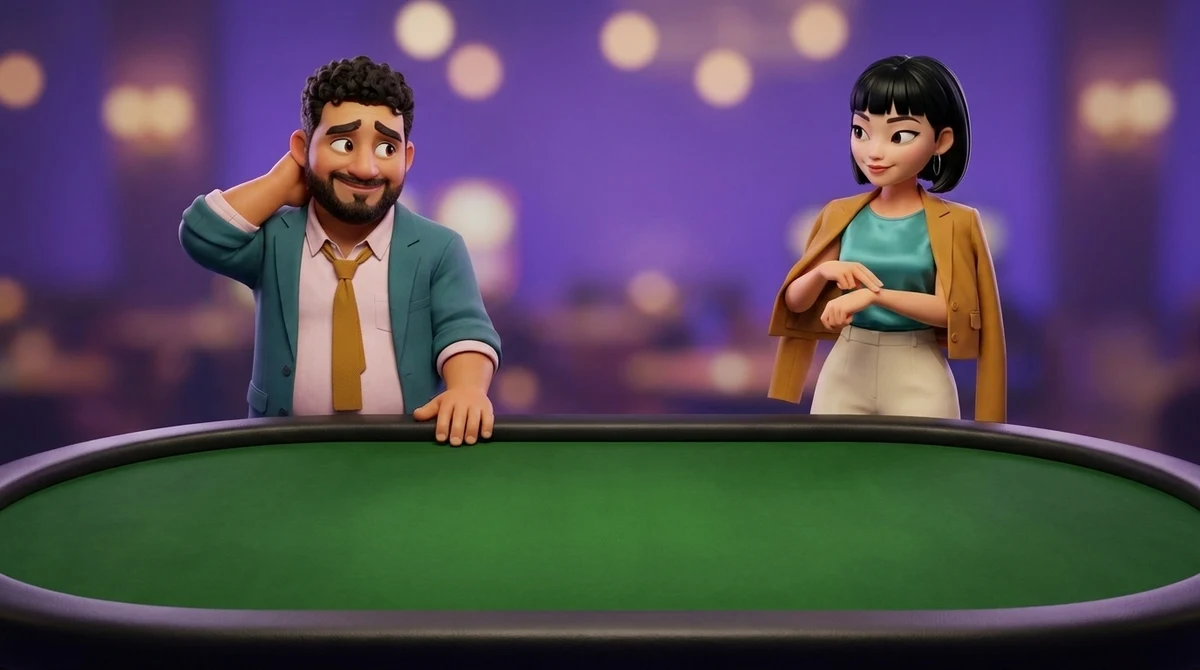

Mayaformer floor supervisor · manners, money and breaks
The hand that hurts most is rarely the one you misplayed. It is the one you played the way you meant to and still lost on the last card. That is when a player starts playing to get the pot back instead of playing the next hand, and that is the minute I would rather you spent with the plan.
What tilt is
Tilt is the word poker players use for a state of play, not for a card. Researchers describe it as an episode in which a player can no longer control the game by rational decisions. In their survey of online poker players, how often tilt episodes happened and distorted thinking about gambling were the only significant predictors of excessive online gambling. The players in that survey played online, and nothing on this page carries the finding over to a live room.
No Chilean document we could read defines tilt. What the national regulator and a casino operator ask of players reads like a list of its warning signs: settle your problems before you play, because if you play to escape them, you may forget them for a while, but they will still be there; do not play to recover your losses; play to have fun, not for gain.
- Before you startPlan the time and the amount of money for the evening in advance.
- Before you sit downSettle your problems first: playing to escape them does not make them go.
- After a lossDo not play to recover your losses.
- At the tablePlay to have fun, not for gain: you cannot influence the results.
The four steps are the pages’ advice laid out in the order of an evening; nothing here adds them up or scores them.
A river with two outs
After the turn, the fourth card on the board, the aces were ahead, and only two cards could put the queens ahead: two outs, the word players use for the cards still to come that would put a hand ahead. Counted with the other player’s cards unknown, as they were at the table, 2 of the 46 cards you could not see gave the queens three of a kind.
46 cards you could not see after the turn, 2 of them marked: the cards that give the other player three queens.
Each square is one card you could not see after the turn. The lettered squares are the cards that gave the other player three queens, and one of them came on the river: 4.3% of rivers.
Cards like that come. Chance decided who took this pot, and the card that came does not change whether putting the chips in with the aces was a sound decision: telling a decision from its result is lesson 7.8, and counting outs is lesson 7.7. The next hand starts from a shuffled deck, with nothing owed to anyone.

Leoformer dealer · rules and maths
I dealt plenty of rivers like that one. Nobody at the table was owed the next pot because of it, and the deck I shuffled for the next hand did not remember it.
If you get up: your seat
The SCJ catalogue has one rule for a player who needs to get up from the poker table: the seat is kept for fifteen minutes, once the Jefe de Sala, the floor manager, has been told. It is a rule of the table, the same in every casino in the country, and it says how long the seat waits, not when to get up.
Chips cannot be bought in the middle of a hand either: a player who runs out of chips during a betting round waits until that hand is over. The list, the buy-in and the first hour are lesson 7.3.
Knowing when to leave
The Chilean pages for players do not say when to stand up. They say why to play and what not to do after a loss: play to have fun, not for gain, and do not play to recover your losses. After a painful loss, three decisions come up, and the plan you made at home has an answer to each.
- Buy in again right now?Only if the plan has another buy-in; a loss does not add one.
- Move up in stakes to get it back?Never: the stakes were chosen at home, and a loss does not choose them again.
- Play the next hand?Inside the time and the money the plan still has, and not to get the last pot back.
A buy-in, the chips you buy when you sit down, is an amount the casino sets and the SCJ approves, and a later purchase can only bring your chips back up to that amount, never past it. One buy-in in the plan means one buy-in; a second one bought to replace a loss is a new limit, not the old one. Moving up in stakes, to a table with bigger blinds, to get a loss back is chasing with bigger bets; chasing losses has a lesson of its own, lesson 10.3. The room also takes a commission, a percentage the casino sets, the SCJ approves and the room posts, so over an evening the money the whole table plays for shrinks.
When it is more than one night
The American Psychiatric Association lists the signs of gambling disorder, and one of them is chasing: after losing money gambling, often coming back to get even. A diagnosis, by the manual that list follows — DSM-5-TR, the 2022 revision — needs at least four of the signs on that list during the past year. One sign is not a diagnosis, one rough night is not one either, and nothing on this page diagnoses anyone.
One painful evening
- A river that hurt, and a pull to get it back.
- Answered by the plan and, if it keeps pulling, by self-exclusion.
What a diagnosis needs
- Several signs from a longer list, over a year.
- Made by a professional, never by a page like this one.
A Chilean operator’s page for players lists coming back another time to try to get lost money back among the criteria of disordered gambling too.
Money and time in the poker room
The plan for an evening in the poker room is a few things decided before the first hand: how many buy-ins, which stakes, what time it ends, and what a painful hand earns. Each line below is one of those decisions.
- Before you goHow many buy-ins the evening gets and what time it ends, written down at home, out of money you do not need day to day.
- At the tableA painful hand is a reason to look at the plan, not for a bigger bet or a bigger table.
- Stop whenA bet goes up to get a pot back; the buy-ins in the plan are spent; the time in the plan is up.
- If it stops being funSelf-exclusion, which keeps you out of every casino in the country, in the guide to self-exclusion.

Mayaformer floor supervisor · manners, money and breaks
The step players skip most often after a painful hand is the look at the plan, and it is the one that keeps the loss from making the next decision with your money.
If getting it back has started to feel like the reason you go, self-exclusion lets you keep yourself out of every casino in the country, and it is right below.
If it stops being fun
If gambling stops being fun, the SCJ self-exclusion applies in every casino in the country. Minimum entry age: 18 (age of majority under Law 19.221; Law 19.995 bars minors from gaming rooms). The casino may ask for an official ID. More on responsible gaming.
Show all regions
Practice: after a painful loss
Most moments begin just after a river like the one at the start of this page, with a plan for the evening written at home. Three decisions come up, each met several times at a different seat and with a different pot: buying in again right away, moving up in stakes to get it back, and playing the next hand. A last moment closes the evening.
Nothing is scored here. There is no strip to fill: every moment is read through once, in order, with every answer explained. The amounts are examples, not suggested buy-ins or stakes, and nothing is bet. Amounts are in betting units, not pesos: a unit can stand for any amount, and the arithmetic is the same at any scale.
Lesson done
Review my mistakes (0)
Progress stays in this browser; nothing is sent anywhere.
The practice table needs JavaScript. Here is one moment from it, with the answer.
Buy in again right now?
TONIGHT’S PLAN
- BLINDS, AN EXAMPLE TABLE1 unit and 2 units
- BUY-INS IN THE PLAN1 of 200 units
- IN FRONT OF YOU NOWnothing
A pot of 410 units has just gone the other way on the river.
The hand that just ended
On the button, at an example table with blinds of 1 unit and 2 units, your whole 200 units buy-in went in a pot of 410 units, lost on a river the other player had 2 outs for. Your plan had one buy-in. Buy in again right now?
- No: the plan had one buy-in, it is spent, and the evening at this table ends here One buy-in means one buy-in. The amount was set at home, before the river, and the river does not change it.
- Yes, another 200 units, to get the pot back before the table changes A second buy-in bought to get a loss back is chasing: a Chilean operator’s responsible-gaming page says plainly not to play to recover your losses.
- Yes, but only 100 units, half as much as before Half a buy-in is still a buy-in the plan never had: the limit moved, only by less.
Maya: The regulator’s advice is to plan the time and the money for the evening in advance. The plan you wrote at home is the one thing at the table that was decided before the river.
Most moments in the practice run start from the same river and a plan for the evening written at home; only the amounts, which are examples, the plan and your seat at the table change.
How the practice run works
Where the moments come from. Most moments start from the same river and a plan for the evening, and every wrong answer is a step outside the plan or the thought that leads to one: a second buy-in bought by the loss, bigger stakes to get a pot back, money from outside the plan, or hands played to get even. The two outs on the river are counted by the same engine as the rest of this track; nothing in the run is random.
Your progress stays in this browser, and nothing is sent anywhere.
Check yourself
Mayaformer floor supervisor · manners, money and breaks
Three quick ones. Pick an answer, then check it. No timer, no points: just whether it stuck.
Back to the question we opened with. The next hand can wait. A look at the plan from home first, and the game taken up again only if that plan still has the time and the money for it.
Help, tools and further reading
18+ across Chile · Play responsibly · self-exclusion is further up this page
Further reading
- Catálogo de Juegos (Poker: Texas Hold’em) · Superintendencia de Casinos de JuegoThe regulator’s rules for Texas Hold’em in the room: signing up, the buy-in, blinds and button, the betting rounds, the showdown and the casino’s commission.
How it’s worked out
Sources, numbers, help and hosts
Where this happens. Every moment on this page is an evening in a poker room you can walk into, where players play against each other and the room takes a commission. A screen at home has tools and limits of its own, and this course does not cover it.
Sources. What tilt is comes from a study; the advice on planning the time and the money, on settling your problems before you play, on playing for fun and on not playing to recover losses comes from the responsible-gaming pages of the national regulator and of casino operators: it is advice, not a rule of any room. How long a seat waits, the buy-in, buying more chips and the commission come from the SCJ catalogue of games, the same rules in every casino in the country. The study of tilt surveyed online poker players, and its finding is not carried over to a live room. The sign of gambling disorder is told in our own words from a page of the American Psychiatric Association, which names the manual it follows; that page is not quoted, and its button links to the page. Every other claim carries a button with the sentence it rests on, the publisher who wrote that sentence and the date we read it; the sentences of the Chilean documents are in Spanish.
Our readings. No Chilean document we could read defines tilt, so the list of warning signs above is our reading of the pages’ advice, not a definition. No Chilean document we could read advises taking breaks or leaving while it is going well, so this page gives neither as advice: the fifteen minutes of the seat are a rule of the table, told as the catalogue prints it, and letting a hand go by in the practice run is our own reading of what keeps the plan.
Numbers. The two outs of the river and their share of the unseen cards are worked out when the page is built by the same engine as the rest of this track, with the other player’s cards counted as unknown, the way they were at the table; that way of counting is our reading. The fifteen minutes are the ones the SCJ catalogue prints. The amounts in the practice run are examples, not suggested buy-ins or stakes.
Help. The help block comes from the data this site keeps for the country: we found no gambling helpline for Chile in the sources we could read, so the block names the national self-exclusion and the regulator’s switchboard, and nothing on this page prints a phone number of its own.
What is deliberately absent. There is no questionnaire on this page, ours or anyone else’s: the description of tilt is a description, not a score, and nothing here diagnoses anyone. Counting outs and the exact odds are lesson 7.7. Telling a decision from its result is lesson 7.8. The buy-in, the list and the first hour are lesson 7.3. Chasing losses at any game is lesson 10.3. Setting the limit itself is lesson 0.2.
Hosts. Maya and Leo are illustrated characters. Their backstories, a former floor supervisor and a former dealer, are written for the course: neither is a real person, and neither speaks for any casino. The rules and numbers on this page come from the sources it cites, not from their experience.
No promise. Poker is played against other players, and the room takes its commission. Knowing what tilt looks like makes the step outside the plan easier to see before you take it; nothing on this page gets a pot back, and nothing here says how an evening would end.
The time and the money, planned
Planifica con anticipación el tiempo y monto de dinero que usarás para divertirte.Free translation: Plan ahead the time and the amount of money you will use to have fun.
Superintendencia de Casinos de Juego (SCJ) · Decálogo de Juego Responsable · read
Planifica con anticipación el tiempo y monto de dinero que invertirás en divertirte. No permitas que el juego te limite en otras actividades importantes y no arriesgues el dinero que necesitas para el día a día o tus proyectos de vida.Free translation: Plan ahead the time and the amount of money you will spend on having fun. Do not let gambling limit you in other important activities, and do not risk the money you need for your day-to-day life or your life projects.
Dreams · Juego responsable: Decálogo del juego responsable · read
Saber de antemano el tiempo y el dinero que voy a dedicar al juego como entretenimiento, es la mejor manera de no caer en el juego compulsivo o patológico.Free translation: Knowing in advance the time and money that I am going to devote to gambling as entertainment is the best way to avoid falling into compulsive or pathological gambling.
Define un presupuesto dedicado al juego que sea compatible con tus posibilidades económicas y comprométete a no superarlo en ningún caso.Free translation: Set a gambling budget that is compatible with your financial means and commit to never exceeding it under any circumstances.
Marina del Sol (MDS Casinos) · Juego responsable: las definiciones del juego · read
Tilt in a study
‘Tilt’ in poker describes an episode during which the player can no longer control their game by rational decisions.
MDPI, full text via Europe PMC · Moreau, Chauchard, Sévigny and Giroux, IJERPH 17(14):5013 (2020) · read
Do not chase a loss
No juegues para “recuperar las pérdidas”.Free translation: Do not gamble to "recover your losses".
Marina del Sol (MDS Casinos) · Juego responsable: las definiciones del juego · read
Do not play to recover a loss
No juegues para “recuperar las pérdidas”.Free translation: Do not gamble to "recover your losses".
Marina del Sol (MDS Casinos) · Juego responsable: las definiciones del juego · read
Tilt in a study
‘Tilt’ in poker describes an episode during which the player can no longer control their game by rational decisions.
MDPI, full text via Europe PMC · Moreau, Chauchard, Sévigny and Giroux, IJERPH 17(14):5013 (2020) · read
A survey of online poker players
The final sample was composed of 291 online poker players.
The findings indicated that the frequency of tilt episodes and cognitive distortion were the only significant predictors of excessive online gambling
MDPI, full text via Europe PMC · Moreau, Chauchard, Sévigny and Giroux, IJERPH 17(14):5013 (2020) · read
Settle your problems first
Resuelve tus problemas antes de jugar. Si juegas para evadirlos, quizás los olvides por un rato, pero los problemas seguirán ahí.Free translation: Solve your problems before playing. If you play to escape them, you may forget them for a while, but the problems will still be there.
Superintendencia de Casinos de Juego (SCJ) · Decálogo de Juego Responsable · read
Do not chase a loss
No juegues para “recuperar las pérdidas”.Free translation: Do not gamble to "recover your losses".
Marina del Sol (MDS Casinos) · Juego responsable: las definiciones del juego · read
Play for fun, not for gain
Cuando juegues, elige hacerlo para entretenerte y no para ganar. Recuerda que no puedes influir en los resultados del juego.Free translation: When you play, choose to do it to be entertained and not to win. Remember that you cannot influence the results of the game.
Superintendencia de Casinos de Juego (SCJ) · Decálogo de Juego Responsable · read
El jugador responsable juega para divertirse y entretenerse, no para ganar dinero. Sabe que puede tener suerte y ganar, pero que también puede perder.Free translation: The responsible player plays to have fun and be entertained, not to make money. They know they may be lucky and win, but that they may also lose.
Marina del Sol (MDS Casinos) · Juego responsable: el jugador responsable · read
The time and the money, planned
Planifica con anticipación el tiempo y monto de dinero que usarás para divertirte.Free translation: Plan ahead the time and the amount of money you will use to have fun.
Superintendencia de Casinos de Juego (SCJ) · Decálogo de Juego Responsable · read
Planifica con anticipación el tiempo y monto de dinero que invertirás en divertirte. No permitas que el juego te limite en otras actividades importantes y no arriesgues el dinero que necesitas para el día a día o tus proyectos de vida.Free translation: Plan ahead the time and the amount of money you will spend on having fun. Do not let gambling limit you in other important activities, and do not risk the money you need for your day-to-day life or your life projects.
Dreams · Juego responsable: Decálogo del juego responsable · read
Saber de antemano el tiempo y el dinero que voy a dedicar al juego como entretenimiento, es la mejor manera de no caer en el juego compulsivo o patológico.Free translation: Knowing in advance the time and money that I am going to devote to gambling as entertainment is the best way to avoid falling into compulsive or pathological gambling.
Define un presupuesto dedicado al juego que sea compatible con tus posibilidades económicas y comprométete a no superarlo en ningún caso.Free translation: Set a gambling budget that is compatible with your financial means and commit to never exceeding it under any circumstances.
Marina del Sol (MDS Casinos) · Juego responsable: las definiciones del juego · read
How long a seat waits
si un jugador requiere levantarse de la mesa, podrá hacerlo reservándole su puesto por un tiempo de 15 minutos, previa notificación al Jefe de Sala.Free translation: if a player needs to leave the table, they may do so, with their seat reserved for 15 minutes, after notifying the Jefe de Sala.
Section III.3 Poker, 3.5.7 Texas Hold’em Poker (con y sin límites); 3.6.3 Prohibiciones al jugador; I.6 Resolución de conflictos
No chips during a hand
Cuando un jugador quede sin fichas en alguna ronda de apuestas, no puede comprar fichas durante el transcurso de este pase, debiendo esperar hasta que culmine el mismo.Free translation: When a player runs out of chips in any betting round, he may not buy chips during the course of this hand and must wait until it ends.
Section III.3 Poker, 3.5.7 Texas Hold’em Poker (con y sin límites); 3.6.3 Prohibiciones al jugador; I.6 Resolución de conflictos
The buy-in, and buying more
Cada jugador debe realizar una compra de fichas o traer fichas por el monto que cubra la caja inicial (Buy in), antes de comenzar a jugar cuyo monto es definido por el casino y aprobado por la Superintendencia.Free translation: Before starting to play, each player must buy chips or bring chips for the amount that covers the initial stake (Buy in), which amount is defined by the casino and approved by the Superintendencia.
las compras adicionales que los jugadores realicen sólo pueden ser por el monto correspondiente al saldo restante para completar el monto definido para la compra o caja inicial (Buy in) señalada.Free translation: additional purchases made by players may only be for the amount corresponding to the remaining balance needed to complete the amount defined for the purchase or initial stake (Buy in) indicated.
Section III.3 Poker, 3.5.7 Texas Hold’em Poker (con y sin límites); 3.6.3 Prohibiciones al jugador; I.6 Resolución de conflictos
The room’s commission
La comisión es de un porcentaje establecido por el casino y aprobado por la Superintendencia de Casinos de Juego y deberá ser indicado en la sala de juego, a través de la señalización correspondiente.Free translation: The commission is a percentage set by the casino and approved by the Superintendencia de Casinos de Juego, and must be displayed in the gaming room by means of the corresponding signage.
Section III.3 Poker, 3.5.7 Texas Hold’em Poker (con y sin límites); 3.6.3 Prohibiciones al jugador; I.6 Resolución de conflictos
De lo recaudado, el 90,9090909% será considerado para el pozo a repartir mediante tabla de pago adjunta, mientras que el 9,0909091% será el derecho a silla (win) del Casino.Free translation: Of the amount collected, 90,9090909% will be allocated to the prize pool to be distributed according to the attached payout table, while 9,0909091% will be the Casino's seat fee (win).
Enjoy (Casino Rinconada S.A.) · Bases «Torneo Poker Turbo Knockout EPL N°2 Rinconada 2024» · read
Signs of gambling disorder
Told on this page in our own words; the source is not quoted.
American Psychiatric Association · What is Gambling Disorder? · read
Coming back to get it back
Después de perder dinero en el juego, se vuelve en otro momento para intentar recuperarlo (tratando de 'cazar' las propias pérdidas).Free translation: After losing money gambling, the person returns at another time to try to recover it (trying to 'chase' their own losses).
Marina del Sol (MDS Casinos) · Juego responsable: adicción al juego · read